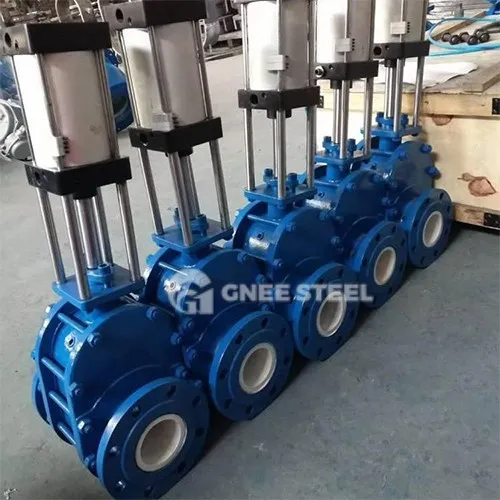
The double-disc gate valve is a valve that uses two parallel gates as opening and closing parts. Its core design achieves high-pressure sealing and anti-wear performance through a combined gate structure. The specific features are as follows:
1. Basic structure and working principle
Double-disc composition
The main gate and the auxiliary gate are connected by a connecting rod or spring to form a separable parallel structure. When closed, the pressure of the outer medium pushes the gate to close to the valve seat.
Sealing principle
Spring preload: A spring is set between the gates to automatically compensate for the wear of the sealing surface when closed to ensure sealing under low pressure.
Medium pressure self-sealing: Under high pressure conditions, the fluid pressure forces the gate to form a rigid contact with the valve seat to achieve two-way zero leakage (ANSI B16.104 VI level standard).
Opening and closing action
The valve stem drives the main gate to move vertically, and the auxiliary gate moves synchronously through the connecting rod. When opened, the gate is retracted into the valve cavity as a whole, and the path is unobstructed.
2. Core performance advantages
Erosion resistance and wear resistance
The gate surface is sprayed with tungsten carbide or ceramic materials (such as zirconium oxide), which can withstand the erosion of particle-containing media, and the service life is 2-3 times longer than that of a single gate.
The specially designed gate edge can scrape off impurities (such as welding slag, mud and sand) on the sealing surface to avoid blocking.
Low-pressure seal enhancement
The spring preload compensates for the lack of thrust of the low-pressure medium, and the sealing pressure is as low as 0.01MPa to maintain effective sealing.
Safety protection design
Fireproof structure: The valve seat adopts metal hard seal + graphite ring, which can still maintain sealing at high temperature (in compliance with API 607 standard).
DBB function: Supports double blocking and release test, and can detect valve sealing online.

3. Typical application scenarios
| Field | Applications | Compatible models |
|---|---|---|
| Oil and gas transportation | High-pressure natural gas pipelines (Class 600 and above), sand-containing crude oil pipelines | API6D K-type expansion double gate valve |
| Chemical Metallurgy | Cut-off control of corrosive media (such as sulfuric acid, caustic soda) | Ceramic Sealed Double Disc Gate Valve |
| Hydropower and Municipal Engineering | Sewage treatment plant interception, water plant main pipe opening and closing | Z44F-16C Parallel Double Disc Valve |
4. Selection and Use Points
Selection Recommendations
For high-pressure impurity-containing media, the configuration of tungsten carbide spray gate + metal valve seat is preferred.
For corrosive fluids, a fully lined ceramic double gate valve should be used to avoid metal parts from contacting the medium.
Operation Specifications
The opening and closing speed must be ≤0.3m/s to prevent the gate and valve seat from impact deformation.
It is strictly forbidden to operate in a partially open state for a long time to avoid vibration and wear of the gate caused by eddy currents.
Maintenance Requirements
Check the spring preload every 6 months. If the torque deviation exceeds 15%, the spring assembly needs to be replaced.
High-temperature grease (such as molybdenum disulfide-based grease) needs to be added every 3 months under high-temperature conditions.