

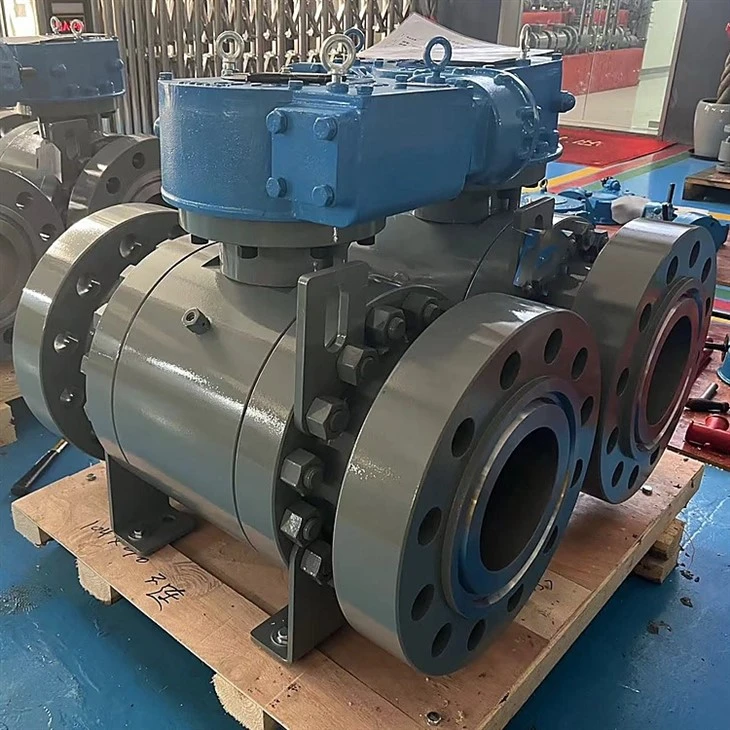


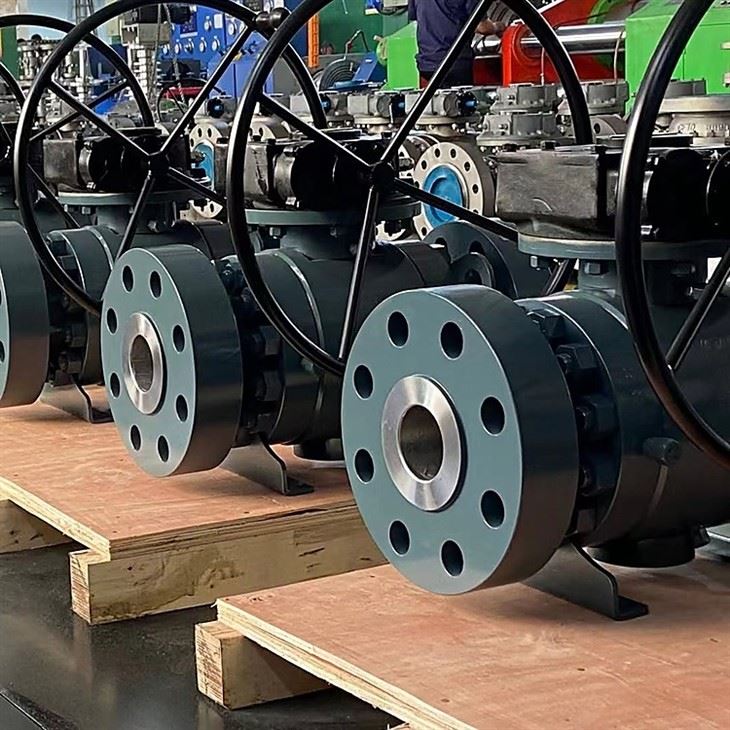
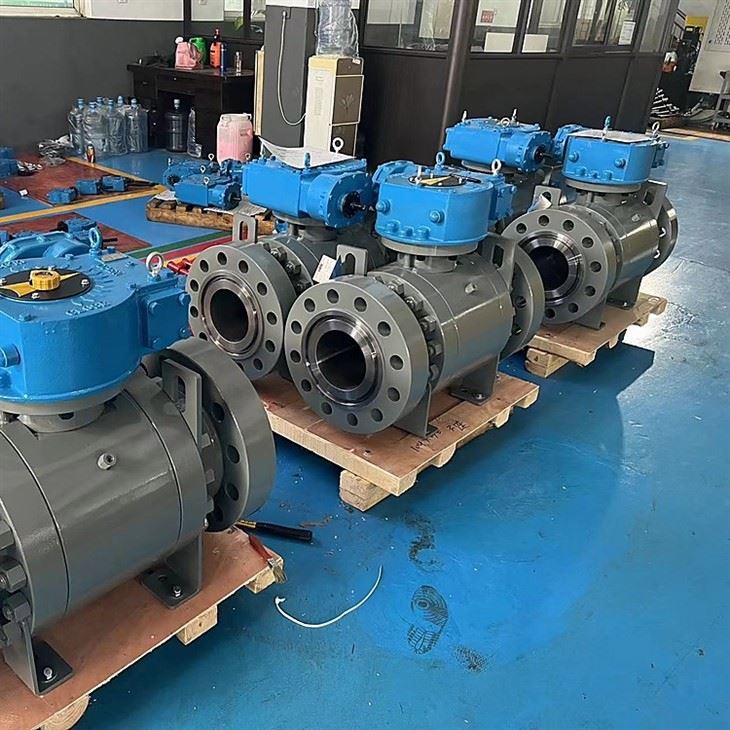
A trunnion ball valve is a quarter-turn isolation valve whose ball is held by upper and lower trunnion bearings instead of being pushed against the downstream seat by line pressure. Spring-energized seats move onto the fixed ball, so operating torque stays low as size and pressure rise. This line covers side-entry split bodies in DN50 to DN600 (NPS 2 to NPS 24), ASME Class 150 to Class 2500, with forged or cast bodies, soft or metal seats and flanged, RTJ or butt-weld ends. Design follows API 6D and ASME B16.34, which makes the type the usual choice for pipeline, ESD and high-pressure process isolation.
Buyers choose this construction when a line has to be isolated reliably at high pressure or large bore. Because the bearings carry the pressure load instead of the seats, operating torque stays predictable and seat life is longer, which also makes the valve easier to automate. Independent seats allow double block and bleed, so the body cavity can be vented and the isolation verified before a joint is opened. These are the reasons the design is specified for trunk pipelines, station piping and emergency shutdown systems.
trunnion ball valve Specification
- Construction – Split Body, Trunnion Ball
- Body Material – Forged/Casting Stainless Steel and Carbon Steel
- Seat – Soft or Metal to Metal
- Size Range – DN50-DN600
- End Connection – Flange, RF, RTJ, BW
- Pressure Rating – Class 150-2500
- Standard – Design to ASME B16.34, API6D/API608, Flange Dimension to ASME B16.5, Butt Welding to ASME B16.25, Face to face meets ASME B16.10, API6D, and Inspection and testing according to API598 API6D
- Temperature Rage – -50°F – 650°F (Soft or Metal Seats)
I Need The Technical Datasheet
Trunnion Mounted Ball Valves-design Features

Trunnion Ball Valve: Trunnion Mounted Ball Valve Compared With Floating Ball Valve
The two designs are separated by how the ball is supported, not by the name printed on a catalogue. A floating ball valve uses line pressure to push the ball into the downstream seat; a trunnion mounted ball valve anchors the ball on upper and lower bearings and moves the seats onto it. That one change controls torque, practical size, isolation function and price.
| Item | Floating ball valve | Trunnion mounted ball valve |
|---|---|---|
| Ball support | Held between the two seats; no shaft support | Top stem and bottom trunnion in bearings |
| Sealing force | Line pressure loads the ball onto the downstream seat | Spring-energized and pressure-assisted seats move onto a fixed ball |
| Practical band | Small bore, typically NPS 1/2 to 6, Class 150 to 600 | NPS 2 to 24 in this line, Class 150 to 2500; larger on request |
| Torque trend | Rises with pressure and size | Comparatively low at high differential pressure |
| Isolation | Downstream seal only; DBB not inherent | Independent seats allow DBB and DIB arrangements |
| Typical duty | Utility and general process isolation | Pipeline mainline, ESD, high-pressure gas, critical isolation |
A size boundary alone is not a specification. Confirm the cutover against the piping class, differential pressure and actuator torque for the actual line.
API 6D Ball Valve And ASME B16.34: What Each Standard Covers
Buyers often write a single standard on a trunnion ball valve RFQ and assume it covers everything. It does not. API 6D governs pipeline valves and their testing; ASME B16.34 sets pressure-temperature ratings and wall thickness for a material group. Face-to-face dimensions and end preparations sit under separate standards.
| Document | What it sets | What to state on the inquiry |
|---|---|---|
| API 6D | Pipeline valve design, DBB and cavity relief provisions, testing and marking | Whether the project requires API 6D scope or a monogrammed supply |
| ASME B16.34 | Pressure-temperature classes, material groups and pressure boundary rules | Class, body material group and design temperature |
| ASME B16.10 / API 6D | Face-to-face dimensions | Required dimension standard and end style |
| ASME B16.5 or B16.47 | Flanged end dimensions | RF or RTJ, flange class and standard |
| ASME B16.25 | Butt-weld end preparation | Pipe schedule and weld-end detail |
| API 598 / ISO 5208 | Pressure test procedure and seat leakage classes | Test medium and acceptance rate |
| API 607 / API 6FA | Fire-type test basis for soft-seat designs | Whether a fire-test report is required |
| ISO 15848-1 / API 641 | Fugitive-emission test basis for stem packing | Emission class where the project specifies one |
Double Block And Bleed Ball Valve: Seat Arrangements
A double block and bleed ball valve is defined by the seats and the cavity, not by the body shape. Choose the seat behavior from the isolation duty first, then check the relief path.
| Arrangement | Behavior | Selection point |
|---|---|---|
| Single piston effect (SPE) | Seals from bore pressure; upstream seat can relieve cavity pressure | Common for liquid lines with thermal expansion risk |
| Double piston effect (DPE) | Seals from either bore or cavity pressure | Positive isolation; needs a separate cavity relief path |
| DBB | Both seats seal independently so the cavity can be vented and checked | State it as a function and test the assembled valve |
| DIB-1 | Each seat is DPE; cavity isolated both sides | Specify the relief connection explicitly |
| DIB-2 | One DPE and one SPE seat | Relief direction follows the SPE seat |
On gas pipelines and metering runs, DBB is usually written into the valve data sheet. On liquid service, a DPE pair without a relief path is a common specification error.
Cast Steel Trunnion Ball Valve And Other Body Materials
Body and trim are chosen from the medium and temperature, not from the pressure class alone. The limits below are the usual specification values checked against a mill certificate; a project specification takes precedence.
Chemical Composition, Percent By Mass
| Element | ASTM A216 WCB | ASTM A351 CF8M | ASTM A105 (forged) |
|---|---|---|---|
| Carbon | 0.30 max | 0.08 max | 0.35 max |
| Manganese | 1.00 max | 1.50 max | 0.60 to 1.05 |
| Silicon | 0.60 max | 1.50 max | 0.10 to 0.35 |
| Phosphorus | 0.04 max | 0.04 max | 0.035 max |
| Sulfur | 0.045 max | 0.04 max | 0.035 max |
| Chromium | 0.50 max residual | 18.0 to 21.0 | 0.30 max residual |
| Nickel | 0.50 max residual | 9.0 to 12.0 | 0.40 max residual |
| Molybdenum | 0.20 max residual | 2.0 to 3.0 | 0.12 max residual |
Mechanical Properties, Minimum Unless Stated
| Property | A216 WCB | A351 CF8M | A105 |
|---|---|---|---|
| Tensile strength (MPa) | 485 to 655 | 485 | 485 |
| Yield strength (MPa) | 250 | 205 | 250 |
| Elongation in 2 in (%) | 22 | 30 | 22 |
| Reduction of area (%) | 35 | not specified | 30 |
| Typical condition | Normalized or as-cast and tempered | Solution annealed | Normalized or annealed |
A cast steel trunnion ball valve in WCB and a forged A105 body are not interchangeable at every temperature. The material group controls the ASME B16.34 rating, and sour service must name the trim hardness separately.
Metal Seated Trunnion Ball Valve And Soft Seat Options
| Seat material | Service note | Check before ordering |
|---|---|---|
| RPTFE | General chemical and hydrocarbon isolation | Temperature ceiling and differential pressure |
| Nylon / Devlon | Dry gas and pipeline duties | Moisture and media compatibility |
| PEEK | Higher temperature and aggressive media | Seat loading and cost |
| Metal seat with hard facing | Solids, erosion or elevated temperature | Agreed leakage rate and surface finish |
Full Bore Trunnion Ball Valve Sizes And Tolerances
Size tables and drawings must be read together. The class and end style decide face-to-face length and weight; the bore choice decides whether a pig can pass.
| NPS | DN | Class range | End options | Typical use |
|---|---|---|---|---|
| 2 to 4 | 50 to 100 | 150 to 2500 | RF, RTJ, BW | Wellhead and unit isolation |
| 6 to 12 | 150 to 300 | 150 to 2500 | RF, RTJ, BW | Mainline and ESD stations |
| 14 to 24 | 350 to 600 | 150 to 900 | RTJ, BW | Trunk pipeline isolation |
A full bore trunnion ball valve is selected when pigging or minimum pressure drop governs. Reduced bore is acceptable where the line-loss calculation allows it; state the minimum internal diameter rather than the word full alone.
Dimensional And Test Acceptance
| Check | Basis | Acceptance point |
|---|---|---|
| Face to face | ASME B16.10 or API 6D | Within the tabulated limit for size and class |
| Flange ends | ASME B16.5 or B16.47 | RF or RTJ detail and bolt pattern as specified |
| Butt-weld ends | ASME B16.25 | Bevel and pipe schedule matched |
| Shell test | API 598 / API 6D | 1.5 x rated pressure, no visible leakage |
| Seat test | API 598, ISO 5208 rate A or D as agreed | 1.1 x rated pressure; each seat separately |
| Anti-static continuity | API 6D | Ball, stem and body continuity per the test record |
| Documentation | Project specification | Material certificate such as EN 10204 3.1, test record, GA drawing |
GNEE Trunnion Ball Valves Product list


Download Datasheet Or Get Free Quote Now - Reliable Manufacturer.
Process Flow Diagram

Digitizingvalve Workshop

CNC Seiko Workshop

Test Center

Valve Product Display

Trunnion Ball Valve RFQ Checklist
A short but complete inquiry gets a usable offer. Send the line list or valve data sheet with the fields below; anything unknown should be marked to be confirmed so it can be reviewed rather than assumed.
| Field | What to send |
|---|---|
| Size and rating | NPS or DN, pressure class and pipe schedule |
| Service | Medium, phase, solids, H2S or CO2, design and operating pressure and temperature |
| Construction | Side or top entry, full or reduced bore, split or welded body |
| Materials | Body, ball, stem, seats, seals and bolting requirements |
| Seat function | SPE, DPE, DBB, DIB-1 or DIB-2 and cavity relief direction |
| Ends | RF, RTJ or BW with flange or weld standard |
| Operation | Lever, gear, pneumatic or electric; torque, fail position and signal feedback where automated |
| Standards and files | Design and test standards, fire-safe or emission requirement, inspection and document list |
| Commercial | Quantity, destination and required date |
Request a quotation with the line list and service conditions attached.
Participate in exhibitions

FAQ
When should a floating ball valve be changed to a trunnion mounted ball valve?
Use a floating design for smaller, lower-class utility lines where line pressure can load the downstream seat without excessive torque. Move to trunnion construction when size or pressure makes that seat load impractical: many projects change over around NPS 6 to NPS 8 at Class 300 and above, earlier for high-pressure gas or automated ESD duty. Confirm the cutover with torque data and the piping class rather than a single size rule.
Does every API 6D ball valve provide double block and bleed?
No. Double block and bleed ball valve duty needs two seats that each seal independently and a cavity vent or drain to prove the isolation. A single-piston-effect seat with only a self-relieving upstream seat is not a DBB arrangement. State DBB, DIB-1 or DIB-2 explicitly on the data sheet and have the test performed as a DBB unit, not as two separate seat tests.
Why does a trunnion ball valve need cavity pressure relief?
When both seats are closed, liquid trapped in the body cavity can expand as temperature rises. Without a relief path, that pressure can damage a seat or the pressure boundary. A self-relieving upstream seat, a thermal-relief seat arrangement or an external cavity relief valve is selected from the seat design and the service fluid; the chosen direction must appear on the drawing.
Can a metal seated trunnion ball valve meet bubble-tight shutoff?
Metal seats are chosen for temperature, solids or erosion, not usually for the tightest soft-seat leakage class. Ask for the actual test basis: soft seats are commonly checked to ISO 5208 Rate A, while general metal-seat acceptance is Rate D unless a tighter level is agreed. Do not assume a metal-seated valve carries a Rate A certificate without a stated test.
What is the difference between full bore and reduced bore in this range?
A full bore trunnion ball valve has a bore close to the pipe inside diameter, which suits pigging and low pressure drop. A reduced bore has a smaller seat and ball, lowering weight and cost where the flow loss is acceptable. State the bore type and, for pigged lines, the minimum internal diameter and the pig type on the inquiry.
Which end connection should be specified for a buried pipeline valve?
Butt-weld ends are common on buried mainlines because they remove a flanged joint, while RF or RTJ flanges suit station and above-ground connections where the line must be disassembled. Give the flange standard and pipe schedule with the end type: ASME B16.5 or B16.47 for flanges and ASME B16.25 for butt-weld preparation.
What should a trunnion ball valve RFQ include?
At minimum: size, pressure class, bore type, medium, design temperature and pressure, body and trim materials, seat arrangement, end connection, operation, applicable standards, inspection and documentation scope, quantity and destination. Mark unknown items as to-be-confirmed instead of letting a supplier assume them; a short line list is enough to start the review.
Hot Tags: Trunnion Ball Valve, China Trunnion Ball Valve manufacturers, suppliers, factory, ball valve transfer valves, ball valve levers, ball valve models, ball valve dimensions, ball valve installation, ball valve linear actuators