

A pressure seal tilting disc check valve is two independent decisions sold as one product: a disc that pivots on a shaft set close to its own centre of mass, and a cover held shut by line pressure rather than by studs. A non-return valve high pressure service is therefore two problems in one body: the disc decides the first 200 milliseconds after a pump trips, and the cover decides the next ten years. Two numbers that decide whether the valve fits are, unusually, missing from every product standard: the face-to-face length, because ASME B16.10 has no tilting disc column, and the head loss, because it follows a disc angle that no standard fixes.
Design Standard
| Basic Design | BS 1868 / ASME B16.34 |
| Face to Face/End to End | ASME B16.10 |
| Flanged End | ASME B16.5 |
| Buttwelding End | ASME B16.25 |
| Pressure–temperature Rating | ASME B16.34 |
| Inspection and Test | API 598 |
Design Features
1. Segmental thrust ring absorb al the thrust applied by the internal pressure.
2. Thrust rings to prevent deformation of the gaskets.
3. Easy to operate and maintain on-line. The rotating center pin is close to the center of gravity, so there is no slide between disc seal cone surface and seat, and water hammer is greatly reduced.
4. Conical sealing surface faces to the center automatically, so it can be applied in vertical pipe, which the medium flow direction from bottom to the top.
5. Quickly open and close, to effectively prevent medium backflow and reduce the water hammer.
Pressure Seal Tilting Disc Check Valve Drawing

Material of Construction
| Part No. | Part Name | Carbon Steel | High Temperature |
|---|---|---|---|
| 1 | Body | ASTM A216 Gr.WCB | ASTM A217 Gr.C12A |
| 2 | Seat | ASTM A105+HF* | ASTM A182 F91+HF* |
| 3 | Disc | ASTM A216 Gr.WCB+HF* | ASTM A217 Gr.C12A+HF* |
| 4 | Pin | ASTM A182 F6a | ASTM A182 F6a |
| 5 | Bonnet | ASTM A105 | ASTM A182 F91 |
| 6 | Seal Ring | ASTM A276 Type 304L | ASTM A276 Type 304L |
| 7 | Thrust Ring | ASTM A182 F6a | ASTM A182 F6a |
| 8 | Segmental Thrust Ring | ASTM A182 F6a | ASTM A182 F6a |
| 9 | Support Plate | ASTM A182 F6a | ASTM A182 F6a |
| 10 | Stud | ASTM A193 Gr.B7 | ASTM A193 Gr.B16 |
| 11 | Nut | ASTM A194 Gr.2H | ASTM A194 Gr.7 |
| 12 | Lifting Lug | Steel | Steel |
| 13 | Bushing | ASTM A182 F6a | ASTM A182 F6a |
| 14 | Packing | Graphite | Graphite |
| 15 | Plug Screw | ASTM A29 Gr.1035 | ASTM A182 F6a |
| 16 | Plug Screw Washer | ASTM A276 Type 316 | ASTM A276 Type 316 |
*HF: Hard-faced with stellite 6 or equivalent.
Dimension & Weight
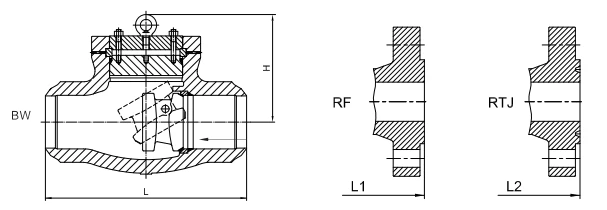
CLASS 600
| Size | L | L1 | L2 | H | Approx Weight(WB) | ||||||
|---|---|---|---|---|---|---|---|---|---|---|---|
| DN | NPS | mm | in | mm | in | mm | in | mm | in | kg | lb |
| 50 | 2 | 178 | 7.00 | 292 | 11.50 | 295 | 11.62 | 165 | 6.50 | 22 | 49 |
| 80 | 3 | 254 | 10.00 | 356 | 14.00 | 359 | 14.12 | 185 | 7.28 | 24 | 53 |
| 100 | 4 | 305 | 12.00 | 432 | 17.00 | 435 | 17.12 | 227 | 8.94 | 45 | 99 |
| 150 | 6 | 457 | 18.00 | 559 | 22.00 | 562 | 22.12 | 298 | 11.73 | 110 | 243 |
| 200 | 8 | 584 | 23.00 | 660 | 26.00 | 663 | 26.12 | 332 | 13.07 | 209 | 461 |
| 250 | 10 | 711 | 28.00 | 787 | 31.00 | 790 | 31.12 | 383 | 15.08 | 499 | 1100 |
| 300 | 12 | 813 | 32.00 | 838 | 33.00 | 841 | 33.12 | 410 | 16.14 | 787 | 1735 |
| 350 | 14 | 889 | 35.00 | 889 | 35.00 | 892 | 35.12 | 451 | 17.76 | 1073 | 2366 |
| 400 | 16 | 991 | 39.00 | 991 | 39.00 | 994 | 39.12 | 511 | 20.12 | 1356 | 2989 |
| 450 | 18 | 1092 | 43.00 | 1092 | 43.00 | 1095 | 43.12 | 552 | 21.73 | 1642 | 3620 |
| 500 | 20 | 1194 | 47.00 | 1194 | 47.00 | 1200 | 47.25 | 591 | 23.27 | 1927 | 4248 |
| 600 | 24 | 1397 | 55.00 | 1397 | 55.00 | 1407 | 55.38 | 645 | 25.39 | 2667 | 5880 |
CLASS 900
| Size | L | L1 | L2 | H | Approx Weight(WB) | ||||||
|---|---|---|---|---|---|---|---|---|---|---|---|
| DN | NPS | mm | in | mm | in | mm | in | mm | in | kg | lb |
| 50 | 2 | 216 | 8.50 | 368 | 14.50 | 371 | 14.62 | 147 | 5.79 | 28 | 62 |
| 80 | 3 | 305 | 12.00 | 381 | 15.00 | 384 | 15.12 | 198 | 7.80 | 39 | 86 |
| 100 | 4 | 356 | 14.00 | 457 | 18.00 | 460 | 18.12 | 244 | 9.61 | 95 | 209 |
| 150 | 6 | 508 | 20.00 | 610 | 24.00 | 613 | 24.12 | 307 | 12.09 | 197 | 434 |
| 200 | 8 | 660 | 26.00 | 737 | 29.00 | 740 | 29.12 | 342 | 13.46 | 229 | 505 |
| 250 | 10 | 787 | 31.00 | 838 | 33.00 | 841 | 33.12 | 412 | 16.22 | 526 | 1160 |
| 300 | 12 | 914 | 36.00 | 965 | 38.00 | 968 | 38.12 | 460 | 18.11 | 823 | 1814 |
| 350 | 14 | 991 | 39.00 | 1016 | 40.00 | 1026 | 40.38 | 495 | 19.49 | 1120 | 2469 |
| 400 | 16 | 1092 | 43.00 | 1130 | 44.50 | 1140 | 44.88 | 556 | 21.89 | 1417 | 3124 |
| 450 | 18 | 1219 | 48.00 | 1219 | 48.00 | 1232 | 48.50 | 581 | 22.87 | 1714 | 3779 |
| 500 | 20 | 1321 | 52.00 | 1321 | 52.00 | 1334 | 52.50 | 619 | 24.37 | 2011 | 4433 |
| 600 | 24 | 1549 | 61.00 | 1549 | 61.00 | 1568 | 61.75 | 695 | 27.36 | 2948 | 6499 |
CLASS 1500
| Size | L | L1 | L2 | H | Approx Weight(WB) | ||||||
|---|---|---|---|---|---|---|---|---|---|---|---|
| DN | NPS | mm | in | mm | in | mm | in | mm | in | kg | lb |
| 50 | 2 | 216 | 8.50 | 368 | 14.50 | 371 | 14.62 | 188 | 7.40 | 37 | 82 |
| 80 | 3 | 305 | 12.00 | 470 | 18.50 | 473 | 18.62 | 194 | 7.64 | 45 | 99 |
| 100 | 4 | 406 | 16.00 | 546 | 21.50 | 549 | 21.62 | 244 | 9.61 | 88 | 193 |
| 150 | 6 | 559 | 22.00 | 705 | 27.75 | 711 | 28.00 | 344 | 13.54 | 209 | 461 |
| 200 | 8 | 711 | 28.00 | 832 | 32.75 | 842 | 33.13 | 412 | 16.22 | 405 | 893 |
| 250 | 10 | 864 | 34.00 | 991 | 39.00 | 1000 | 39.38 | 478 | 18.82 | 638 | 1407 |
| 300 | 12 | 991 | 39.00 | 1130 | 44.49 | 1146 | 45.12 | 529 | 20.83 | 898 | 1980 |
| 350 | 14 | 1067 | 42.00 | 1257 | 49.49 | 1277 | 50.28 | 582 | 22.91 | 1519 | 3349 |
| 400 | 16 | 1194 | 47.00 | 1384 | 54.50 | 1407 | 55.38 | 634 | 24.96 | 2141 | 4720 |
| 450 | 18 | 1537 | 60.50 | 1537 | 60.50 | 1559 | 61.38 | 689 | 27.13 | 2483 | 5474 |
| 500 | 20 | 1664 | 65.50 | 1664 | 65.50 | 1686 | 66.38 | 742 | 29.21 | 2948 | 6499 |
| 600 | 24 | 1943 | 76.50 | 1943 | 76.50 | 1972 | 77.62 | 786 | 30.94 | 4036 | 8898 |
CLASS 2500
| Size | L | L1 | L2 | H | Approx Weight(WB) | ||||||
|---|---|---|---|---|---|---|---|---|---|---|---|
| DN | NPS | mm | in | mm | in | mm | in | mm | in | kg | lb |
| 50 | 2 | 279 | 11.00 | 451 | 17.75 | 454 | 17.87 | 190 | 7.48 | 40 | 88 |
| 80 | 3 | 368 | 14.50 | 578 | 22.75 | 584 | 23.00 | 213 | 8.39 | 57 | 126 |
| 100 | 4 | 457 | 18.00 | 673 | 26.50 | 683 | 26.88 | 242 | 9.53 | 96 | 212 |
| 150 | 6 | 610 | 24.00 | 914 | 36.00 | 927 | 36.50 | 347 | 13.66 | 241 | 531 |
| 200 | 8 | 762 | 30.00 | 1022 | 40.25 | 1038 | 40.87 | 415 | 16.34 | 454 | 1001 |
| 250 | 10 | 914 | 36.00 | 1270 | 50.00 | 1292 | 50.88 | 491 | 19.33 | 775 | 1709 |
| 300 | 12 | 1041 | 41.00 | 1422 | 56.00 | 1445 | 56.88 | 557 | 21.93 | 1241 | 2736 |
Valve Factory


FAQ
What is a tilting disc check valve?
A check valve whose single disc swings open on a shaft set close to its own centre of mass, so the disc lifts away from a seat inclined to the flow instead of hinging from the top of the bore. Because the shaft is near the centre, the mass moment of inertia about that shaft is small and the disc covers its whole stroke quickly. The same geometry puts the shaft and its bushings inside the flow path.
How does a tilting disc check valve work?
Forward flow pushes the disc off an inclined seat and rotates it about 40 degrees to a stop lug in the body, where it sits clear of the main stream. When the flow decelerates the disc falls back through a short arc, and the last few millimetres are closed by the reverse differential acting on the disc face. The valve has no stem, no actuator and no packing, so nothing outside the pipe can hold it open or shut.
Tilting disc vs swing check: which should I choose?
Choose by what is in the pipe and how fast the flow reverses. A swing check keeps its hinge outside the flow and tolerates dirty service, but the disc edge travels about 1.35 times the bore, so it needs a long time to close. A tilting disc travels a short arc and closes sooner, at the cost of a shaft in the stream. For clean water, steam or hydrocarbon above 1.4 m/s, the tilting disc wins on closure. For sludge, fibre or slurry, the swing check is the only one of the two that survives.
What is the correct tilting disc check valve installation position?
Horizontal installation means a horizontal pipe with the pivot shaft horizontal; vertical upflow means a vertical pipe with the flow going up. Never vertical down-flow: the disc then hangs on its seat and the valve looks correct from outside while passing reverse flow. The shaft must stay horizontal in both layouts so that gravity assists closure; rotating the valve about the pipe axis to put the shaft vertical removes that assistance and adds the disc weight to the bushing load.
Pressure seal vs bolted bonnet: which do I need?
On a check valve, choose the pressure seal bonnet for consistency with the rest of a Class 900 and above piping specification, or where the cover is too heavy for a stud circle. A bolted bonnet with a spiral wound gasket seals the same pressure, and it opens in minutes with hand tools. The pressure seal joint seals better as pressure rises but needs a new gasket ring every time it is opened, and the ring is matched to that body's taper, not to its size and class.
What is the pressure drop of a tilting disc check valve?
It depends on the disc angle, which no standard fixes. Crane TP-410 separates two tilting disc geometries by an angle alpha and gives a loss coefficient of 1.689 at 15 degrees and 0.5629 at 5 degrees. Back-calculated against the friction factor used in the same table, those are L/D 120 and L/D 40, against 100 for a swing check and L/D 600 for a lift check. At NPS 6 and 2 m/s the two tilting disc geometries differ by 0.023 bar and about 670 kWh a year.
Can tilting disc be used in wastewater?
Not in raw sewage or anything carrying fibre, wipes or grit. The pivot shaft and its bushings sit in the flow path, so solids wrap the shaft and stop the disc reaching its stop lug. The disc then sits half open, flutters, and wears the bushings oval. Water treatment plants put the shaft out of the stream by using a different closure for influent duty and reserve the tilting disc for cleaner effluent.
Are you a tilting disc check valve manufacturer or a trader?
We are a trading company with our own machining and assembly, and the castings come from nominated foundries whose heat numbers appear on the certificate. We do not claim an API Monogram and we do not print one on the body. What we do control is which foundry pours which class, which shop machines the seat, and where each test happens, and we will name all three for your order before you place it.
Can you supply as a pressure seal check valve supplier against a project specification?
Yes, and the useful part is telling you where the specification cannot be met by any supplier. A line item reading pressure seal tilting disc check valve to API 594 Type B cannot be certified, because API 594 Type B is defined as a bolted cover swing check. Write the body to EN 16767 and ASME B16.34, the bonnet to MSS SP-144, and the length as a number in millimetres.
What does a tilting disc check valve price depend on?
Four things move it more than size: the pressure class, because wall thickness and the pressure seal split ring scale with it; the body material, with WC6 and CF8M well above WCB; whether the seat ring is renewable or integral; and whether the pivot assembly is a weld-in cartridge. A Class 2500 NPS 12 valve is not a scaled-up Class 600 NPS 6 valve, and quoting it as one is how delivery dates slip.
What tilting disc check valve dimensions must I fix before ordering?
Three, and only one of them is in a standard. Fix the face-to-face in millimetres, because ASME B16.10 has no tilting disc column and the number must come from your spool drawing or from a nominated column. Fix the end connection and facing, including whether Class 2500 flanges are within ASME B16.5 at your size. Fix the disc angle or accept the manufacturer's, since it sets the head loss you will live with.
What pressure seal check valve maintenance is required?
Two routines. Grease the pivot bushings on the interval the manual gives, often monthly on large valves, because dry bushings wear oval and a disc that sits off its stop lug flutters. Then inspect the seat and bushings, which means opening the cover, which on a pressure seal body means a new gasket ring. Replace the pivot pin and both bushings as a set once the bore is oval beyond about 0.2 mm; a new pin in a worn bore re-wears in weeks.
How is it tested and what documents come with it?
Shell at 1.5 times the 38 °C rating and seat at 1.1 times, to API 598, with the metal seat allowance of 3 x NPS cm3/min of water recorded per serial number. Documents are EN 10204 3.1 as standard and 3.2 when an inspector witnesses, a dimensional record including the face-to-face actually measured, positive material identification on alloy and stainless bodies, and API 6FA fire test evidence if you ask for it rather than API 607.