

A flat gate valve is a common type of valve. Its working principle involves controlling the flow of fluid by raising and lowering a gate. Specifically, when the valve needs to be opened, the valve stem moves the gate upwards, opening the fluid passage and allowing fluid to flow. When the valve needs to be closed, the valve stem moves downwards, causing the gate to descend and block the fluid passage, thus preventing fluid from passing through.
A flat gate valve mainly consists of a valve body, valve seat, gate, valve stem, and transmission mechanism. The valve body is the main part of the valve and is usually made of cast iron, carbon steel, or similar materials, possessing sufficient strength and rigidity to withstand fluid pressure. The valve seat is a crucial component for valve sealing and is typically made of high-quality materials to ensure sealing performance.
The gate is the key component controlling the flow of fluid, usually made of cast iron, carbon steel, or similar materials, and is rectangular in shape; its up-and-down movement controls the flow. The valve stem connects the transmission mechanism and the gate and is typically made of corrosion-resistant materials such as stainless steel.
GNE Group specializes in the production of flat gate valves. Download the valve performance comparison table to intuitively select the optimal model!
Features of Flat Gate Valves:
1. The valve seat adopts an O-ring seal and a pre-tightening floating seat structure, ensuring bidirectional sealing at the inlet and outlet. Furthermore, the opening and closing torque of this structure is only half that of ordinary valves, allowing for easy opening and closing.
2. When fully open, the flow path is smooth and straight, with extremely low flow resistance and no pressure loss, allowing for easy cleaning of pipelines with a lint ball.
3. Utilizing a self-sealing packing structure, it requires no frequent adjustment, opening and closing are extremely easy, and the sealing performance is reliable. An auxiliary sealing grease injection structure at the stuffing box ensures absolutely reliable sealing performance, truly achieving zero leakage; solving the common problem of external leakage at the packing of general valves.
4. The flat gate valve automatically releases high pressure from the internal cavity when closed, ensuring safe operation.
5. A fully enclosed structure provides excellent protection and is suitable for all-weather conditions.
Flat Gate Valve Technical parameters
|
Product Name |
Flat Gate Valve |
|
Size |
NPS 2" ~ 24, DN50 ~ DN600 |
|
Pressure |
PN16 ~ PN160, Class 150 ~ Class 900LB |
|
Temperature |
-46℃ ~ 120℃ |
|
Installation Method |
Horizontal/ Vertical |
|
Material |
WCB/ LCB/ CF8/ CF8M/ CF3/ CF3M/ WC6/ WC9 |
|
Material Procedure |
Casting |
|
Sealing Material |
PTFE/ R.PTFE/ NYLON/ MOLON/ DEVLON/ PPL/ PEEK/ |
|
Stem Packing |
Graphite/ PTFE/ O-Ring |
|
Operation Type |
Manual, Bevel Gear, Electric, Pneumatic, Pneumatic & Hydraulic |
|
Design Standard |
API 600/ API 602/ ISO 15761 |
|
Face to face |
ASME B16.10/ GB/T 12221/ GOST 3706 |
|
Connection |
ASME B16.5/ GOST 33259/ GOST 12815/ GB/T 9113 |
|
Test Standard |
API 598/ GOST 9544 |
Applications of Flat Gate Valves:
1. (Class 150~900/PN1.0~16.0MPa, operating temperature -29~121℃) Oil and natural gas pipelines. Flat gate valves with flow guide holes also facilitate pipeline cleaning.
2. Refined oil pipelines and storage equipment.
3. Oil and natural gas wellhead equipment, i.e., valves for the wellhead.
4. Pipelines carrying media containing suspended particles.
5. City gas pipelines.
6. Water supply projects.
Advantages of Flat Gate Valves:
- Low flow resistance; the flow resistance of a non-restricted valve is similar to that of a short-bore pipe.
- Flat gate valves with flow guide holes can be directly used for pipeline cleaning with a pipeline pig.
- Because the gate slides on the two valve seat surfaces, flat gate valves are suitable for media containing suspended particles; the sealing surface of the flat gate valve is actually automatically positioned.
- The valve seat sealing surface will not be damaged by thermal deformation of the valve body. Furthermore, even when the valve is closed in a cold state, the thermal elongation of the valve stem will not overload the sealing surface.
- Simultaneously, when the valve is closed, a flat gate valve without a guide hole does not require high precision in the gate's closed position; therefore, the opening and closing position of an electric flat gate valve can be controlled by stroke.
Disadvantages of Flat Gate Valves
- When the medium pressure is low, the sealing force of the metal sealing surface is insufficient to achieve a satisfactory seal.
- Conversely, when the medium pressure is high, if the sealing surface is not lubricated by the system medium or an external medium, frequent opening and closing may cause excessive wear on the sealing surface.
- Another disadvantage is that the circular gate, moving laterally in a circular flow channel, is only sensitive to flow control when it is at 50% of the valve's closed position. Moreover, the gate will vibrate violently when cutting off high-speed and high-density medium flows.
- If the valve seat is made into a V-shaped opening and closely guided to the gate, it can also be used for throttling.
Selection Principles for Flat Gate Valves
1. For oil and natural gas transmission pipelines, select single-gate or double-gate flat gate valves. If pipeline cleaning is required, select single-gate or double-gate flat gate valves with a guide orifice and rising stem design.
2. For refined oil transmission pipelines and storage equipment, select single-gate or double-gate flat gate valves without a guide orifice.
3. For oil and natural gas wellhead installations, select single-gate or double-gate flat gate valves with a floating seat and guide orifice and a non-rising stem design. Most are API 16A standard, with pressure ratings of API 2000, API 3000, API 5000, API 10000, API 15000, and API 20000.
4. For pipelines containing suspended particulate media, select knife-type flat gate valves.
5. For city gas transmission pipelines, select single-gate or double-gate soft-seal rising stem flat gate valves.
6. For urban water supply projects, single-gate or double-gate flat plate gate valves without guide holes and with exposed stems should be selected.
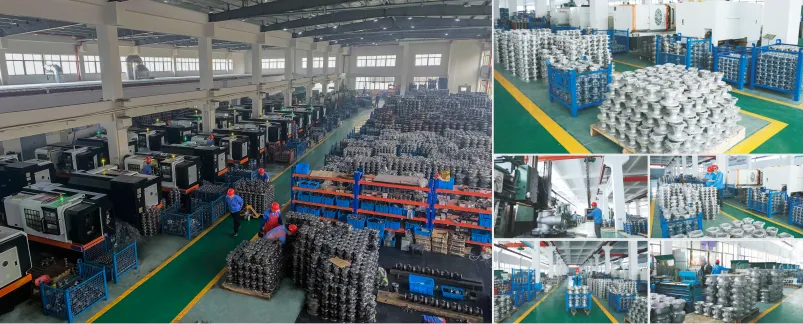
Flat Gate Valves factory
Get a customized valve solution now to solve your fluid control problems!