

1. Structure and features of one-piece ball valves One-piece ball valves are called one-piece ball valves because the valve body adopts an integral structure. It has a small shape and light weight. The ball core, valve seat, and valve stem are installed from the flow channel on one side of the valve body. Due to the limitation of the flow channel size of the valve body, the full-diameter ball core cannot be installed inside the valve body, so the flow channel of the ball core of the one-piece ball valve is reduced. The flow capacity is subject to certain restrictions. There are certain advantages in cost. It is mainly used for low-pressure pipelines.
One-piece ball valves have threaded connections, flange connections, and butt-wafer connections. The thread usually adopts 55° tapered pipe thread, which can obtain better sealing performance. Flange connection is more convenient to install. The butt-wafer connection structure is short in length and can be installed on compact space pipelines. The valve is made of WCB cast steel, stainless steel CF8, CF8M and other materials.
One-piece threaded ball valves are mostly used in low-pressure pipelines because the valve stem stuffing bin is shallow and less sealing stuffing is added.
The one-piece flange ball valve is made into a high-temperature sewage ball valve, which can effectively prevent the medium from leaking out from the valve body, avoiding the risk of medium leakage from the valve body between the two-piece ball valve and the three-piece ball valve. It can be used for steam and heat transfer oil media. It can also be made into an insulation ball valve to transport easy-to-crystallize and solidify media. Hot water, steam and other heat media are passed into the insulation shell to insulate the ball valve.

2. Structure and characteristics of three-piece ball valve The valve body of the three-piece ball valve consists of a main valve body and two auxiliary valve bodies, so it is called a three-piece ball valve. After the ball core and the valve stem are installed in the main valve body, the auxiliary valve body is installed in the valve seat, and the main and auxiliary valve bodies are connected as a whole by bolts. The ball core flow channel is also full-diameter.
The three-piece ball valve also has internal thread connection and external thread connection. The internal thread usually adopts 55° tapered pipe thread, which has good sealing performance. The external thread has a welding joint and can be welded to the pipeline. It is more convenient to disassemble and assemble during maintenance, avoiding the need for a separate joint for the internal thread connection.
Butt welding and socket welding connection, you can also use extended pipe welding to avoid high temperature damage to the valve seat seal and valve stem packing during welding, reducing the difficulty of installation.
The main feature of the three-piece ball valve is that it can be maintained online, which is very convenient. Loosen the screws on the valve body and remove a bolt that passes through the main valve body. Turn the main valve body to replace the valve seat seal. You can also completely remove the main valve body bolts and remove the main valve body for maintenance. The auxiliary valve body is still on the pipeline, avoiding the disassembly of the entire ball valve, greatly reducing the maintenance workload.
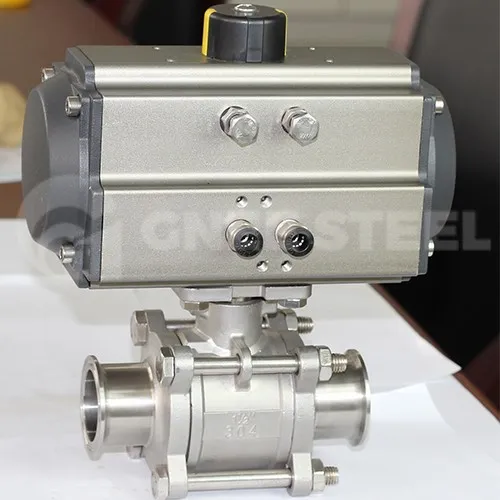
3. The difference between one-piece ball valve and three-piece ball valve
1. The valve body structure is different. The valve body of the one-piece ball valve is integral, and the valve body of the three-piece ball valve is divided into a main valve body and two auxiliary valve bodies, a total of three parts.
2. The ball core flow channel size is different. The one-piece ball valve adopts a reduced diameter flow channel, and the flow capacity is affected to a certain extent. The three-piece ball valve adopts a full-bore flow channel size. The flow resistance is small and the flow capacity is greater. A three-piece ball valve can be selected if there is a flow requirement.
3. The installation and maintenance workload is different. The three-piece ball valve is easier to install and maintain than the one-piece ball valve, and the workload is small. It is convenient to replace the valve seat seal ring, ball core, packing and other parts.
4. The procurement cost is different. The three-piece ball valve of the same specification has the highest cost, and the one-piece ball valve has the lowest cost.