

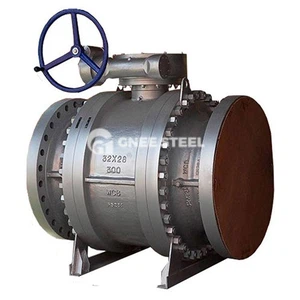
API 6D ball valve is a special ball valve designed, manufactured and tested according to the API 6D standard formulated by the American Petroleum Institute (API). It is designed for long-distance pipelines and harsh working conditions such as oil and natural gas. Its core features are as follows:
1. Core standards and scope of application
Standard attributes: API 6D is the authoritative specification for pipeline valves in the oil and natural gas industry, covering design, material selection, manufacturing process and testing requirements.
Applicable scenarios: long-distance natural gas pipelines, oil storage and transportation systems, buried pipelines and highly corrosive media environments such as hydrogen sulfide.
2. Key design features
Structurally reinforced
Fully welded valve body: The three-section forged steel valve body is formed by fully automatic welding, which completely eliminates the risk of flange leakage and is suitable for direct burial installation.
Fixed ball design: The trunnion-type fixed ball structure (large pivot support) is adopted to keep the center of the ball stable under high pressure and make the seal more reliable.
Sealing technology
Bidirectional sealing valve seat: spring-preloaded piston valve seat, zero leakage in both inlet and outlet (in compliance with ISO 5208 Class A);
Auxiliary sealing system: integrated grease injection interface, which can be temporarily repaired by injecting sealing grease when the seal fails.
Safety protection
Fire-resistant structure: API 607 certified, the metal seal can still maintain a fireproof seal for 30 minutes after the soft seal is burned;
Anti-static design: static conduction device between the ball and the valve stem to avoid explosion caused by medium friction.
3. Performance and test requirements
Adaptation to extreme working conditions
Pressure bearing capacity: up to Class 600 (PN100) 8, compatible with ultra-low temperature (-46℃) to high temperature (200℃);
Sulfur corrosion resistance: special alloys (such as ASTM A352 LCC forged steel) are used to resist hydrogen sulfide stress corrosion.
Strict testing and verification
High-pressure sealing test: zero leakage of gas/liquid dual phase at 1.1 times the working pressure;
Life test: the seal remains after repeated opening and closing for more than 500 times under full pressure difference.
4. Typical application areas
Energy transportation: natural gas trunk line cut-off valve, crude oil storage tank import and export control;
High-risk media: natural gas containing hydrogen sulfide, corrosive chemical raw material pipelines;
No maintenance scenario: direct buried underground pipeline (no valve well required, the operating mechanism extends to the ground).
