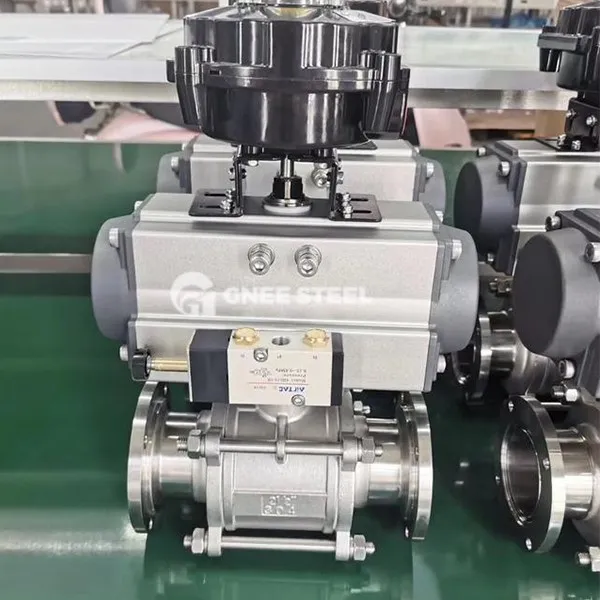
Clamp connection: a connection form that clamps the valve and the two ends of the pipe together with bolts.
Threaded connection:
Commonly used for small valves, it is a simple connection method.
There are two situations:
1. Direct sealing: Use internal and external threads to directly connect the sealing effect. To ensure that the connection does not leak, lead oil, hemp and polytetrafluoroethylene raw tape are generally used for filling; polytetrafluoroethylene raw tape is increasingly widely used. This material has excellent sealing effect and good corrosion resistance. It is more convenient to use and store. When disassembling, it can be completely removed because it is a non-sticky film, which is much better than lead oil and hemp.
2. Indirect sealing: The force of tightening the thread is transmitted to the gasket between the two planes, allowing the gasket to play a sealing role.
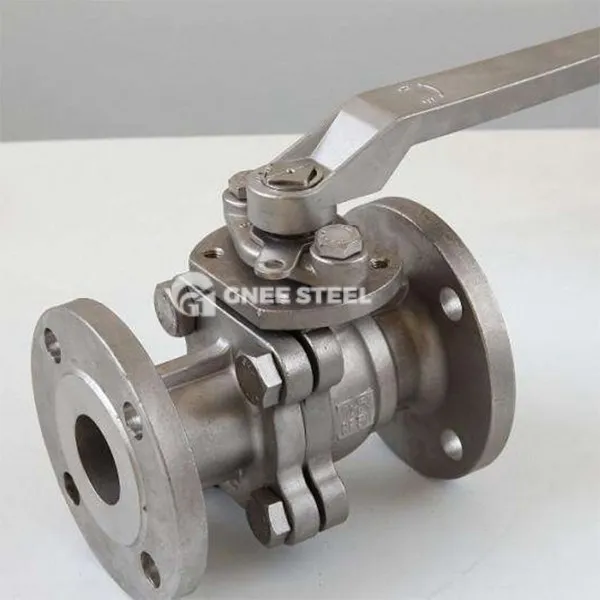
Flange connection: The most commonly used connection form in valves.
According to the shape of the joint surface, it can be divided into the following types: 1. Concave and convex type: The working pressure is high, and medium-hard gaskets can be used 2. Trapezoidal groove type: used for valves with a working pressure of ≥64 kg/cm2, or high-temperature valves. Use an elliptical metal ring as a gasket. 3. Tongue and groove type: widely used in corrosive media, with better sealing effect. Gaskets with larger plastic deformation can be used. 4. Smooth type: more convenient to process, used for valves with low pressure. 5. O-ring type: developed with the emergence of various rubber O-rings, it is a newer flange connection form. 6. Lens type: used for high-pressure valves or high-temperature valves with working pressure ≥100 kg/cm2. The gasket is lens-shaped and made of metal.
Ferrule connection: ferrule connection form, which has been adopted in small-diameter valve products in China.
Its connection and sealing principle is: when the nut is tightened, the ferrule is subjected to pressure, so that its blade bites into the outer wall of the pipe, and the outer cone of the ferrule is tightly fitted with the inner cone of the joint body under pressure, so it can reliably prevent leakage. The advantages of this connection form are: 1. It is easy to install at high altitude. 1. Low processing precision requirements; 2. Small size, light weight, simple structure, easy to disassemble and assemble; 3. A variety of materials can be selected, suitable for corrosion protection; 4. Strong connection force, wide range of use, can withstand high pressure (1000 kg/cm2), high temperature (650℃) and impact vibration
Butt welding connection: a connection method that directly welds the valve and the pipeline together.
Internal self-tightening connection: This is a connection form that uses medium pressure for self-tightening. Its sealing ring is installed at the inner cone, forming a certain angle with the side facing the medium. The medium pressure is transmitted to the inner cone and then to the sealing ring. On the cone surface at a certain angle, two component forces are generated, one is parallel to the center line of the valve body and outward, and the other is pressed against the inner wall of the valve body. The latter component force is the self-tightening force. The greater the medium pressure, the greater the self-tightening force. Therefore, this connection form is suitable for high-pressure valves. It saves a lot of materials and manpower compared to flange connection, and only requires a certain pre-tightening force so that it can be used reliably when the pressure in the valve is not high. Valves made using the self-tightening sealing principle are generally high-pressure valves.
Clamp connection: suitable for low-pressure valves that are frequently disassembled. It only requires two bolts to install it, which is a quick connection method.
There are many forms of valve connection, such as some small valves that do not need to be removed are welded to the pipe; some non-metallic valves use socket connections, etc. Valve users should treat them according to specific circumstances.
Related accessories
There are valves and pipe fittings, which are used in pipeline connections or control systems. Valves and pipe fittings cannot exist independently, but complement each other. Valves and pipe fittings are made of carbon steel and stainless steel, as well as PVC or other materials. In recent years, with the improvement of people's living standards, the demand for non-staple food has increased. Therefore, it has led to the rapid development of food machinery, so the stainless steel sanitary valve and pipe fittings production industry has become prosperous, and stainless steel sanitary valves and pipe fittings are more popular.