

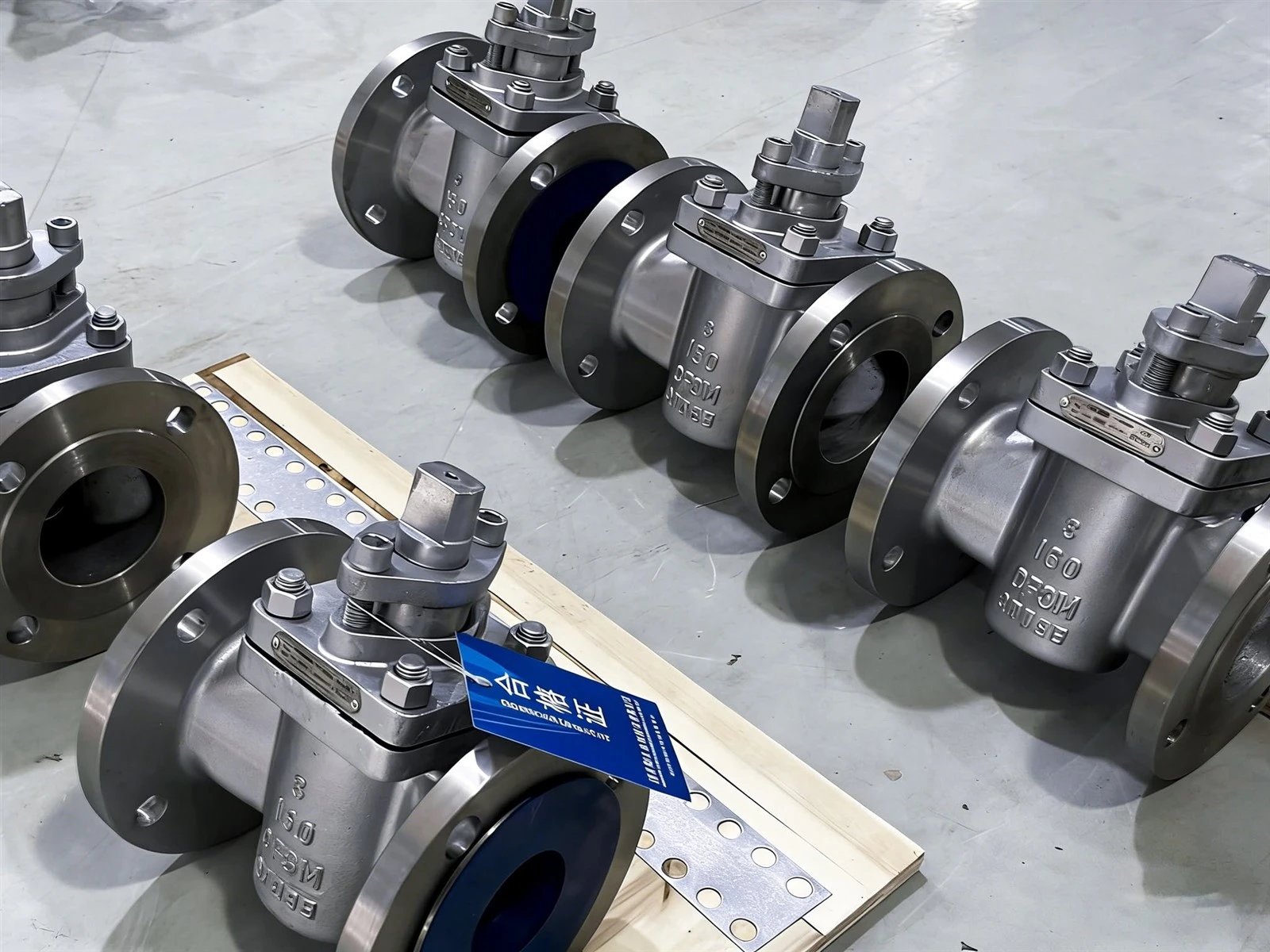
A two-way stainless steel plug valve is a quarter-turn isolation valve with two coaxial ports, one flow path and a cylindrical or tapered plug that rotates 90° to open or close the line; the configuration comes straight from the scope of API 599, which covers two-way coaxial ports and excludes three-way and four-way designs. Bodies run from NPS ½ to NPS 24 (DN 15–600) in Class 150 to 600, in ASTM A351 CF8, CF8M or CF3M, with a PTFE, reinforced PTFE or PEEK sleeve on non-lubricated designs, and a soft seat holds to no visible leakage (ISO 5208 Rate A). Three decisions decide whether the delivery fits the line: which standard governs the order, sleeved or lubricated, and port pattern against the pressure loss the system can carry.
GNEE supplies two-way stainless steel plug valves in both the non-lubricated sleeved design and the lubricated taper design, flanged or welded ends, with fire-safe and low-emission options where the line calls for them. Send the size, class, medium and temperature and we will come back with the design route, the trim and the testing schedule the same day.
Two-way Stainless Steel Plug Valve specification
| Item | Typical Options |
|---|---|
| Valve type | Two-way plug valve |
| Construction | Stainless steel |
| Valve operation | Quarter-turn |
| Port arrangement | Two-way, coaxial flow path |
| Plug design | Lubricated or non-lubricated, depending on model |
| Body materials | Stainless steel grades such as CF8, CF8M, CF3, CF3M, or equivalent grades as specified |
| Pressure class | PN-rated or ASME Class-rated designs |
| End connections | Flanged, threaded, socket-weld, or butt-weld, depending on design |
| Operation | Lever, gear, pneumatic, electric, or other actuator arrangements |
| Testing | In accordance with the applicable valve standard and purchase specification |
| Documentation | MTC, test reports, inspection documents and other project records as required |
Dimensions, Face-to-Face and Flange Drilling
| DN | NPS | Length, short series (mm) | Length, mid series (mm) | Lever square □s (mm) | Height, open H (mm) |
|---|---|---|---|---|---|
| 15 | ½ | 108 | 130 | 14 | 99 |
| 20 | ¾ | 117 | 130 | 14 | 124 |
| 25 | 1 | 127 | 140 | 17 | 133 |
| 32 | 1¼ | 140 | 165 | 18 | 152 |
| 40 | 1½ | 165 | 165 | 26 | 212 |
| 50 | 2 | 178 | 203 | 28 | 260 |
| 65 | 2½ | 190 | 222 | 32 | 295 |
| 80 | 3 | 203 | 241 | 40 | 327 |
| 100 | 4 | 229 | 305 | 45 | 425 |
| 125 | 5 | 245 | 356 | 54 | 482 |
| 150 | 6 | 267 | 394 | 62 | 512 |
| 200 | 8 | 292 | 457 | 75 | 605 |
| 250 | 10 | 330 | 533 | 85 | 660 |
| 300 | 12 | 356 | 610 | 100 | 760 |
The gap between the two series is the point of the table: at DN 300 it is 254 mm, and at DN 150 it is 127 mm. Lever square and height are reference values for layout and packaging; final dimensions are issued on the approval drawing.
| DN | NPS | Face-to-face, B16.10 short pattern (mm) | Flange OD D (mm) | Bolt circle D1 (mm) | Bolt holes z-φd |
|---|---|---|---|---|---|
| 15 | ½ | 108 | 90 | 60.5 | 4 × φ15.9 |
| 20 | ¾ | 117 | 100 | 69.9 | 4 × φ15.9 |
| 25 | 1 | 127 | 110 | 79.4 | 4 × φ15.9 |
| 32 | 1¼ | 140 | 115 | 88.9 | 4 × φ15.9 |
| 40 | 1½ | 165 | 125 | 98.6 | 4 × φ15.9 |
| 50 | 2 | 178 | 150 | 120.7 | 4 × φ19.1 |
| 65 | 2½ | 190 | 180 | 139.7 | 4 × φ19.1 |
| 80 | 3 | 203 | 190 | 152.4 | 4 × φ19.1 |
| 100 | 4 | 229 | 230 | 190.5 | 8 × φ19.1 |
| 125 | 5 | 254 | 255 | 215.9 | 8 × φ22.2 |
| 150 | 6 | 267 | 280 | 241.3 | 8 × φ22.2 |
| 200 | 8 | 292 | 345 | 298.5 | 8 × φ22.2 |
| 250 | 10 | 330 | 405 | 362.0 | 12 × φ25.4 |
| 300 | 12 | 356 | 485 | 431.8 | 12 × φ25.4 |
Two-way Plug Valve Design Options
A two-way stainless steel plug valve can be configured in different ways depending on the application.
Lubricated Plug Valve
A lubricated plug valve uses a lubricant to reduce friction between the plug and body sealing surfaces. It can be considered for applications where the operating conditions and valve design call for lubrication.
Non-lubricated Plug Valve
A non-lubricated plug valve uses a sealing system that does not require routine injection of lubricant during normal operation. Sleeve-lined and other non-lubricated designs are available for specific industrial services.
Flanged Plug Valve
Flanged designs are commonly used where the valve needs to be installed between flanged pipeline components. The flange standard and pressure class should be confirmed with the piping specification.
Threaded or Weld-end Plug Valve
For smaller sizes or particular piping configurations, threaded, socket-weld, or butt-weld connections may be specified.
The correct configuration depends on the pipeline design rather than on the valve name alone.
Two-way Stainless Steel Plug Valves Application
Two-way stainless steel plug valves are suitable for many industrial flow-isolation duties where the valve materials and sealing system are compatible with the service.
Typical applications include:
Chemical Processing
Stainless steel construction can be selected for process lines carrying corrosive or chemically active media, subject to compatibility verification.
Petrochemical and Oil & Gas
Plug valves can be used for shut-off and isolation duties in petroleum and process systems. For oil and gas projects, the buyer should specify the required valve standard, pressure class, material, testing, fire-safe requirements, and documentation.
Water and Process Treatment
Stainless steel plug valves can be considered for process water, treatment chemicals, and other services where the selected stainless steel grade provides adequate corrosion resistance.
Industrial Process Systems
They can also be supplied for general industrial piping where compact quarter-turn operation and reliable isolation are required.
The valve should not be selected by industry name alone. Medium, pressure, temperature, flow characteristics, corrosion conditions, and required leakage performance should be reviewed before final selection.


Send us your valve list, MTO, datasheet, or project specification.
We can review the available requirements and confirm:
Suitable two-way plug valve configuration
Stainless steel material options
Pressure and temperature requirements
End connection
Applicable valve standard
Testing and inspection scope
Required quality documents
Quantity and quotation basis
FAQ
What is a two-way stainless steel plug valve?
A two-way stainless steel plug valve is a quarter-turn isolation valve with two primary flow connections and a rotating plug. Stainless steel construction is selected when the application requires suitable corrosion resistance and mechanical performance.
What is the difference between a two-way and three-way plug valve?
A two-way plug valve has two primary pipeline connections for straightforward flow isolation. A three-way plug valve has an additional flow path and can be used to divert or mix flow, depending on the port configuration.
Is a stainless steel plug valve suitable for corrosive media?
It can be, but suitability depends on the specific medium, concentration, temperature, pressure, and valve wetted materials. Stainless steel grade selection should be based on the actual service conditions.
Is every two-way plug valve API 599 compliant?
No. API 599 defines requirements for covered metal plug valves, but a valve should only be claimed as API 599 compliant when its design, materials, testing, and manufacturing meet the applicable requirements.
Can a two-way stainless steel plug valve be supplied as an API 6D valve?
Yes, where the specific valve design and manufacturing scope meet the applicable API 6D requirements. API 6D includes plug valves, but the designation should not be applied to a generic plug valve without verifying the applicable requirements.
What information should I provide for a plug valve quotation?
At minimum, provide valve type, size, pressure class, material, medium, operating temperature and pressure, end connection, quantity, required standard, destination, and inspection/documentation requirements. A valve datasheet, MTO, or existing valve list is even better.
Can you quote from an existing valve datasheet?
Yes. Sending an existing datasheet, MTO, valve list, or previous quotation can make it easier to check the required specifications and prepare a comparable quotation.
What documents can be supplied with stainless steel plug valves?
Depending on the order requirements, documentation may include MTCs, pressure-test reports, PMI reports, dimensional inspection reports, ITPs, certificates of conformity, and third-party inspection records.