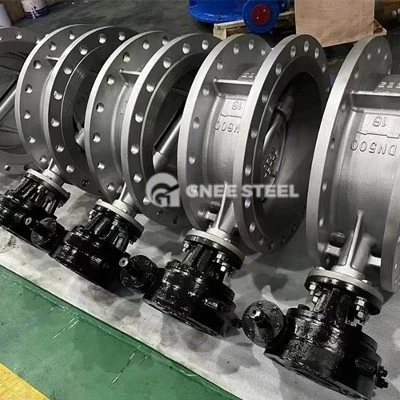
A three-eccentric butterfly valve is an enhanced version of the double-eccentric design. The term "three-eccentric" refers to the addition of an angular eccentricity to the double-eccentric configuration (where the stem axis deviates from both the disc center and the valve body centerline). This results in a sealing surface with a tapered conical profile.
In this design, the outer periphery of the disc is machined into an external tapered cone, while the inner surface of the sealing seat is machined into a matching internal tapered cone. This structure not only increases the contact area between the seat and the disc but also significantly improves sealing performance.
Technical Specifications of Butterfly Valves
Nominal Diameter (DN): DN50 ~ DN1000
Seat Material: Alloy, Stellite, Stainless Steel
Nominal Pressure (PN): 1.0 MPa ~ 4.0 MPa
Connection Type: Flanged, Wafer (Lug Type)
Operating Temperature: -20°C ~ +150°C (Standard) / Up to 600°C (High-Temperature Option)
Actuation: Manual, Gear, Pneumatic, Electric
Body Material: Cast Steel, Stainless Steel
Manufacturing Standards:
GB (Chinese National Standard)
DIN (German Industrial Standard)
API (American Petroleum Institute)
ANSI (American National Standards Institute)
Suitable Media: Water, Oil, Steam, Gas, Powder, Liquid
Applications:
Oil & Gas, Chemical, Power Generation, Environmental Protection
Water Resources, Heating & Water Supply, Drainage
Industrial & Mechanical Systems
Features & Advantages of Three-Eccentric Butterfly Valves
Excellent Sealing Performance
The triple eccentric design significantly enhances sealing capability.
Maintains reliable sealing even under high-temperature, high-pressure, or corrosive media conditions.
Wear Resistance
The three eccentricities ensure full grinding of the disc during operation, minimizing wear.
Extends valve service life under frequent cycling.
High Adaptability
Simple yet robust structure with easy operation.
Performs reliably across extreme temperatures (both high and low).
Suitable for diverse industrial applications.
Effortless Operation
Near-frictionless or low-friction movement during opening/closing.
Reduces operating torque, ensuring smooth and energy-efficient control.