

What Is a Flange Facing?
A flange facing is the machined surface where the gasket is installed to create a pressure-tight flange joint.
The facing geometry affects:
Gasket selection
Gasket confinement
Required bolt load
Sealing performance
Installation
Maintenance
Compatibility with the mating flange
For buyers, this means that "NPS 6, Class 600" is not a complete flange specification.
A proper inquiry should also identify the flange type and facing, such as:
NPS 6, Class 600, WN flange, RF, ASTM A105
or:
DN150, PN40, EN 1092-1, Type B1, P355
ASME B16.5 covers pipe flanges and flanged fittings from NPS 1/2 through NPS 24 and includes pressure-temperature ratings, materials, dimensions, tolerances, marking and requirements related to flange bolting, gaskets and joints. The current ASME edition is B16.5-2025.
For larger ASME flanges, ASME B16.47 applies.
The Main Flange Facing Types
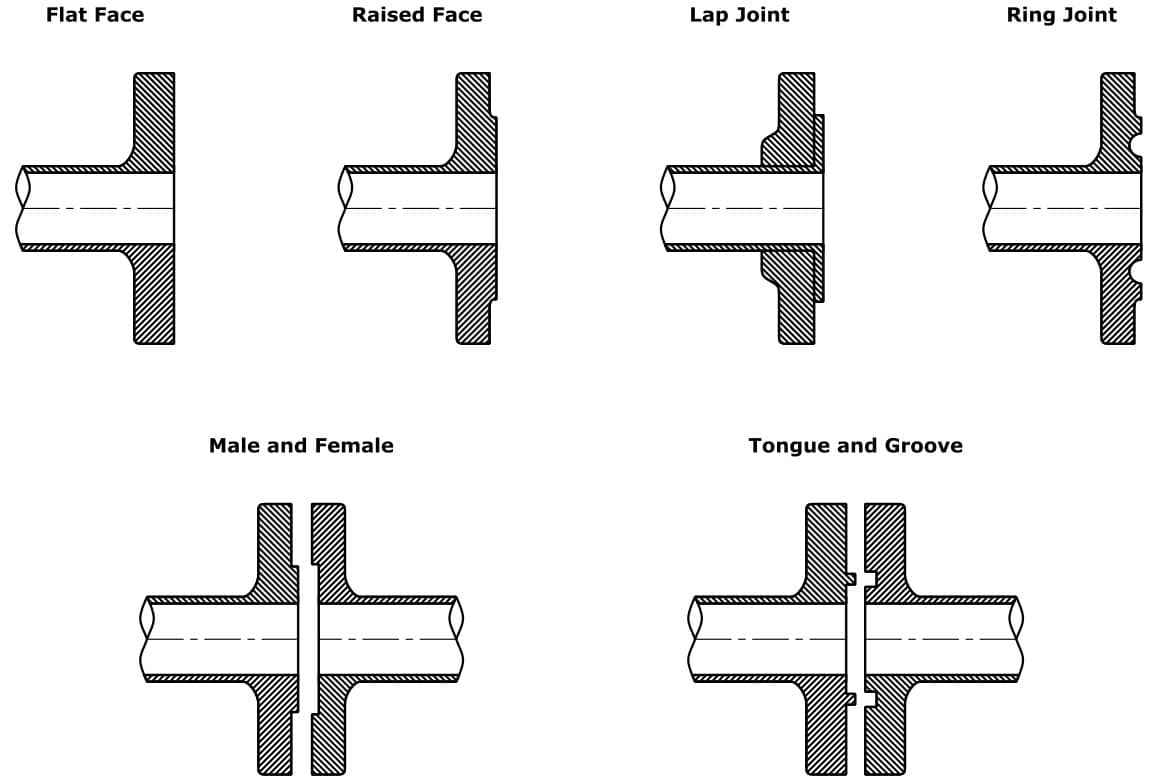
The facing you choose should follow the governing flange standard and the service requirements. There is no universal "best" facing.
1. Raised Face (RF)
Raised Face is the most widely encountered facing in industrial piping.
The sealing surface is raised above the surrounding flange face, concentrating the gasket load over the sealing area.
RF flanges are widely used in:
Oil and gas
Petrochemical plants
Chemical processing
Power generation
Water treatment
General process piping
Industrial valve connections
Advantages
Widely available
Large selection of compatible gaskets
Relatively simple machining
Suitable for a broad range of industrial services
Easy to identify and specify
A common RF surface finish is a serrated finish suitable for gasket sealing. The exact finish requirement should be taken from the governing flange standard and gasket manufacturer's requirements rather than assumed from a generic value.
Typical gasket options
Depending on the service and specification, RF flanges may use:
Spiral-wound gaskets
Compressed fiber gaskets
PTFE gaskets
Expanded PTFE
Kammprofile gaskets
Metal-jacketed gaskets
ASME B16.20 covers metallic ring-joint, spiral-wound and metal-jacketed gaskets and specifies their dimensions, materials, tolerances and markings.
What buyers should know
Do not assume that RF is only suitable for Class 150 or Class 300.
RF is used across a broad range of pressure classes, and the applicable class, size and material determine the actual pressure-temperature rating.
2. Flat Face (FF)
A Flat Face flange has a continuous flat sealing surface across the flange face.
The gasket normally covers the full flange face, including the area around the bolt holes.
FF is commonly associated with:
Cast iron valves and flanges
Ductile iron equipment
Low-pressure water systems
Utility piping
Applications where full-face gasket support is required
Advantages
Full-face gasket support
Lower local bending stress on more brittle flange materials
Straightforward gasket installation
Common in low-pressure water and utility systems
Typical gasket
Common choices include:
Full-face compressed fiber gaskets
Rubber or elastomer gaskets
PTFE-based sheet gaskets
Important compatibility point
Do not assume an FF flange can be bolted directly to an RF flange simply because the bolt pattern matches.
The difference in flange-face geometry can create an unsuitable joint, especially when a brittle flange material is involved. ASME's PCC-1 guidance specifically addresses the consequences of mating flat-faced and raised-face flanges and emphasizes proper joint assembly.
For procurement, specify the facing of both mating flanges, not just one side.
3. Ring Type Joint (RTJ)
Ring Type Joint, commonly abbreviated RTJ, uses a machined annular groove and a metallic ring gasket.
The metal ring is compressed into the groove during assembly to create a high-integrity seal.
RTJ is widely used in:
High-pressure oil and gas
Refineries
Petrochemical processing
Wellhead equipment
High-temperature process service
Critical hydrocarbon service
Why choose RTJ?
The main advantage is the metallic sealing system.
RTJ joints can provide highly reliable sealing under demanding pressure and temperature conditions when the flange, ring gasket and installation procedure are properly matched.
Common RTJ gasket types
Depending on the applicable standard and application, you may encounter:
R type
RX type
BX type
ASME B16.20 covers metallic ring-joint gaskets as well as spiral-wound and metal-jacketed gaskets.
Important procurement point
RTJ is not simply "the Class 600+ flange."
The correct RTJ groove, ring type, material and dimensions must match the applicable flange standard.
For API 6D pipeline valves, for example, flanged ends may be supplied with raised-face or ring-joint facings, with dimensions and finishes tied to the applicable flange standards.
4. Tongue and Groove (T&G)
A Tongue & Groove joint uses two matching flange faces:
One flange has a tongue
The other has a groove
The gasket is positioned within the mating geometry, which helps restrict lateral movement and gasket extrusion.
This can be useful when gasket confinement is important.
Advantages
Good gasket confinement
Reduced risk of gasket extrusion
Good alignment between mating faces
Useful for selected critical or process applications
Limitations
The two mating faces must match
Machining is more complicated than RF
Damage to the tongue or groove can compromise the joint
Replacement and maintenance may be less convenient
The piping arrangement must allow the flanges to be separated correctly
Typical applications
T&G facings are used in selected:
Process equipment
Heat exchanger connections
Pump and valve applications
Critical sealing services
They should not be selected simply because a project has a high pressure class.
The actual selection should come from the equipment design, piping specification and applicable flange standard.
5. Male and Female (M&F)
Male & Female facings use a matching protrusion and recess.
One flange has the male face, while the mating flange has the female recess.
The recess helps locate and retain the gasket.
Advantages
Good gasket positioning
Reduced outward gasket movement
Positive mating of the two flange faces
Useful for selected process and equipment applications
Limitations
Male and female faces must be ordered as a matched pair
More complicated machining
More difficult to replace than a conventional RF gasket
Incorrect mating geometry can make the joint unusable
M&F and T&G are sometimes grouped together because both confine the gasket, but their geometries are different and should not be treated as interchangeable.
6. Lens Ring / Conical Sealing Arrangements
Lens-ring sealing uses a metallic lens-shaped gasket that mates with specially machined conical surfaces.
It is a specialized high-pressure sealing arrangement, rather than one of the everyday flange facings most buyers encounter in standard ASME B16.5 piping.
It may be found in:
High-pressure vessels
Specialized process equipment
High-pressure piping
Certain European and proprietary equipment designs
Because this type of joint depends heavily on precise geometry and surface condition, it should be specified from the equipment or piping design rather than selected from a generic "flange facing chart."
RF vs FF vs RTJ vs T&G vs M&F
| Facing | Main Feature | Typical Gasket | Common Applications | Key Procurement Issue |
|---|---|---|---|---|
| RF | Raised sealing surface | Spiral wound, sheet, PTFE, Kammprofile | General industrial and process piping | Most common; confirm gasket and finish |
| FF | Full flat face | Full-face sheet/elastomer | Cast iron, ductile iron, low-pressure water | Match the mating FF face |
| RTJ | Machined groove + metal ring | R/RX/BX ring gasket | High-pressure/high-temperature oil & gas | Groove and ring must match exactly |
| T&G | Tongue fits groove | Confined gasket | Selected process/equipment applications | Must be supplied as a matched pair |
| M&F | Male fits female recess | Confined gasket | Selected process/equipment applications | Male/female geometry must match |
| Lens ring | Conical metal sealing | Lens ring | Specialized high-pressure equipment | Follow equipment-specific design |
Important: The table is a selection guide, not a pressure-rating table. The allowable pressure depends on the flange standard, size, material, temperature and pressure class.
Characteristics of common flange sealing surfaces
Raised Face (RF)
RF is the most common flange facing for general industrial piping. Its raised sealing area is easy to machine and works with various gasket types. However, the gasket has less lateral support and requires proper bolt preload and gasket selection to prevent extrusion.
Male and Female (M&F)
M&F facings use a male projection and matching female recess to confine the gasket. This reduces gasket movement and can improve sealing performance. However, the two flanges must be accurately matched, and machining and gasket replacement are more difficult than with RF.
Tongue and Groove (T&G)
T&G facings use a tongue and matching groove to confine the gasket and reduce extrusion. They can provide reliable sealing for demanding services, including some high-pressure or hazardous applications. Their disadvantages are more complex machining and more difficult gasket replacement.
Flat Face (FF) and Ring Type Joint (RTJ)
FF provides a full flat sealing surface and is commonly used with cast iron, ductile iron, and lower-pressure water or utility systems.
RTJ uses a metallic ring gasket in a machined groove and is widely used for high-pressure and high-temperature oil, gas, and process applications. Its pressure capability depends on the flange standard, size, material, pressure class, and temperature.
Other Sealing Surfaces
Specialized high-pressure equipment may use conical or trapezoidal sealing surfaces with metallic gaskets such as lens, oval, or octagonal ring gaskets. These designs are typically selected according to the specific equipment or piping standard.
Which Flange Facing Should You Choose?
There is no simple rule such as:
Class 150 = RF
Class 600 = RTJ
Class 900 = RTJ
That is too simplistic.
Instead, consider the following.
Choose RF when:
You need a standard industrial flange connection.
The service is general process, water, air, oil or gas.
A wide range of gasket options is useful.
The project specification calls for RF.
The pressure and temperature are within the applicable flange rating.
RF is usually the easiest option for standard industrial procurement.
Choose FF when:
The mating equipment requires a flat face.
The flange or valve body is made from cast iron or another material where full-face support is important.
The application is relatively low pressure.
The project specification requires FF.
Choose RTJ when:
The project requires a metallic ring-joint seal.
Pressure and temperature are demanding.
The piping specification calls for RTJ.
The application involves critical hydrocarbon service.
API or project specifications require RTJ.
Choose T&G or M&F when:
Gasket confinement is important.
The equipment design specifically calls for the facing.
The project requires a controlled gasket location.
The mating flanges are designed as a matched pair.
The key point is simple:
Select the facing from the complete joint design, not from pressure class alone.
What About Flange Face Finish?
Surface finish is another specification that is often missed in RFQs.
The flange facing needs the appropriate surface condition for the selected gasket.
For example, ASME B16.5 specifies different facing finish requirements for different flange facings. For common flange facings, a serrated finish is used, while T&G/M&F and RTJ sealing surfaces have their own finish requirements.
Do not simply write:
"Standard finish."
If the project has a specific gasket or surface-finish requirement, state it in the purchase specification.
GNEE Pipe Fitting

FAQ
What is the most common flange facing?
Raised Face (RF) is one of the most widely used flange facings in industrial process piping. It is common on steel flanges and supports a wide range of gasket options.
What is the difference between RF and FF flanges?
RF has a raised sealing surface, while FF has a flat sealing surface across the flange face. FF is commonly used with cast iron, ductile iron and other applications where full-face gasket support is important.
Is RTJ better than RF?
Not automatically. RTJ is generally selected when the project requires a metallic ring-joint seal or when service conditions call for that type of joint. RF is usually more practical for general industrial piping.
Which flange face is best for high pressure?
RTJ is widely used for demanding high-pressure and high-temperature applications, but the pressure capability comes from the complete flange design, material, size, temperature and pressure class-not the facing alone.
Can I use an RF flange with an FF flange?
Do not assume that RF and FF can be directly mated. The facing geometry and gasket arrangement are different, and compatibility depends on the materials, joint design and applicable piping specification.
What gasket is used with an RTJ flange?
RTJ flanges use metallic ring gaskets. Common ring types include R, RX and BX designs, depending on the applicable flange standard and service.
What gasket is commonly used with an RF flange?
Spiral-wound gaskets are widely used with RF flanges in process service, but compressed fiber, PTFE, Kammprofile and metal-jacketed gaskets may also be appropriate depending on the medium, pressure, temperature and project specification.
Are RF flanges suitable for Class 900 or Class 1500?
They can be, depending on the applicable standard, size, material and service conditions. Do not assume that a higher pressure class automatically requires RTJ. Check the project specification and governing flange standard.
Are tongue-and-groove flanges better for sealing?
T&G facings provide strong gasket confinement and can be useful for specific sealing requirements. However, they are more specialized than RF and require correctly matched mating faces.
What is the difference between T&G and M&F flange facings?
Both use matching faces to confine and locate the gasket, but their geometries differ. T&G uses a tongue and groove, while M&F uses a projecting male face and a matching female recess.
What information should I send a flange supplier?
At minimum, provide standard, size, pressure class/PN, flange type, facing, material, medium, design pressure, design temperature and gasket requirement. For critical services, also specify inspection, testing and certification requirements.
What standards cover flange facings and gaskets?
Common references include ASME B16.5 for pipe flanges and flanged fittings, ASME B16.47 for large-diameter steel flanges, ASME B16.20 for metallic gaskets, ASME B16.21 for nonmetallic flat gaskets, and EN 1092-1 for PN-designated steel flanges.
ASME currently lists B16.5-2025 as the current edition and B16.20-2023 as the current metallic-gasket standard
References
ASME B16.5 - Pipe Flanges and Flanged Fittings
ASME B16.47 - Large Diameter Steel Flanges
ASME B16.20 - Metallic Gaskets for Pipe Flanges
ASME B16.21 - Nonmetallic Flat Gaskets for Pipe Flanges
ASME PCC-1 - Guidelines for Pressure Boundary Bolted Flange Joint Assembly
EN 1092-1 - Flanges and Their Joints - Circular Flanges for Pipes, Valves, Fittings and Accessories, PN Designated
Need Flanges or Flanged Valves? Talk to GNEE
Send your inquiry to GNEE (Tianjin) Multinational Trade Co., Ltd. and we will confirm the facing, gasket, standard and finish with you before quoting.
Email: sale@gneetube.com