

Overview of Butterfly Valve
Butterfly valve is a valve that realizes fluid switching and flow regulation by rotating the butterfly valve plate (≥90°). It belongs to the category of stop valve. It is characterized by simple structure, small size, light weight, fast opening and closing, and good sealing performance. It is widely used in industrial pipeline systems.
Core structure and working principle
1. Main structural components
Valve body: usually a symmetrical structure, divided into flange type, clamp type and other connection forms.
Valve stem: connects the valve plate and the operating mechanism (manual/electric/pneumatic), and must meet corrosion resistance and strength requirements.
Butterfly plate: core component, common materials are stainless steel, copper, nylon, etc., and the shape is a round thin sheet.
Seal: includes valve seat ring and O-ring to prevent medium leakage (such as EPDM, PTFE and other materials).
Drive device: manual handle, worm gear, pneumatic piston or electric actuator.
2. Working principle
Open/Close: Rotate the valve stem to drive the butterfly plate to rotate 90° around the valve axis to achieve full opening (flow) or full closing (cutoff).
Flow regulation: Control the butterfly plate opening by partial rotation (15°~85°), change the cross-sectional area of the pipeline, and adjust the flow rate.
Classification of butterfly valves
1. Classification by connection method
Flange butterfly valve: Connect the pipeline through flange bolts, suitable for high-pressure and large-diameter scenarios.
Wafer butterfly valve: Adopts double flange clamping structure, easy to install, suitable for medium and low-pressure pipelines.
2. Classification by drive method
Manual butterfly valve: Driven by handle or gear, low cost, suitable for small diameter and non-frequent operation scenarios.
Electric butterfly valve: Equipped with motor and reduction mechanism, remote control and automatic adjustment can be realized.
Pneumatic butterfly valve: Driven by compressed air, fast response speed, suitable for flammable and explosive environments.
3. Classification by sealing form
Elastic sealing butterfly valve: Rely on the pre-tightening force of rubber or plastic sealing ring to achieve sealing (such as soft seal).
Metal-sealed butterfly valve: using metal materials (such as stainless steel, carbide) for contact sealing, resistant to high temperature and high pressure, and long service life.
4. Classification by structural form
Single eccentric butterfly valve: the valve stem axis deviates from the center line of the butterfly plate to improve the opening and closing torque.
Double eccentric butterfly valve: the valve stem axis and the butterfly plate center line form a double offset to reduce friction and extend service life.
Triple eccentric butterfly valve: the highest-end design, completely eliminating friction, suitable for extreme working conditions (such as ultra-high temperature).
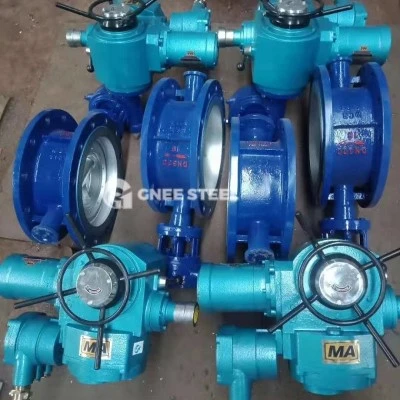
Core advantages of butterfly valve
Compact and light: the volume is only 1/3~1/2 of the ball valve, light weight, saving installation space.
Flexible operation: short opening and closing time (usually <30 seconds), suitable for high-frequency operation.
Reliable sealing: soft-sealed butterfly valve has low leakage rate (up to ANSI VI level), and metal seals are resistant to high temperature and high pressure.
Easy maintenance: some structures can quickly disassemble and replace seals without overall maintenance.
Typical application scenarios
Water treatment system: control water flow direction and flow (such as sewage treatment plants).
Petrochemical: Transporting crude oil, natural gas and other media requires high pressure and corrosion resistance.
HVAC: Regulate the flow of chilled water and steam pipelines.
Pharmaceutical industry: Clean room pipeline control that meets GMP standards.
Fire protection system: Emergency shut-off valve in fire water pipes.
Key parameters for selection
| Parameter | Illustrate |
| Nominal diameter | DN15~DN3000 (small diameter is often used for home use, large diameter is often used for industry) |
| Pressure level | PN16~PN40 (Class 150~Class 2500, metal sealing structure is required for high-pressure scenarios) |
| Media Type | Water, air, oil, acidic and alkaline liquids, natural gas, etc. (need to match the corrosion resistance of the material) |
| Temperature range | -20℃~+400℃ (heat-resistant alloy or special sealing material is required for high temperature working conditions) |
| Connection | Select according to pipe flange standards (such as DNPN, ANSI, JIS, etc.) |
| Drive mode | Manual/electric/pneumatic (determined by operation frequency and automation requirements) |

Common problems and solutions
Leakage problem
Cause: Aging of the sealing ring, wear of the valve seat, deformation of the butterfly plate.
Solution: Replace the O-ring or valve seat, and check whether the butterfly plate is blocked by foreign matter.
Valve blocking
Cause: Impurity accumulation, insufficient lubrication, double eccentric structure design defects.
Solution: Clean the pipeline regularly, use self-lubricating valve stems or add grease.
Corrosion failure
Cause: The corrosiveness of the medium exceeds the tolerance range of the material.
Solution: Select corrosion-resistant materials such as 316L stainless steel and Hastelloy.
Maintenance points
1. Daily inspection
Regularly check whether the valve stem is flexible and whether there is rust or wear.
Observe whether the sealing ring has signs of aging and cracks.
2. Cleaning operation
Use a soft cloth to remove dirt from the outer surface of the valve body and avoid scratches from hard objects.
For wafer-type butterfly valves, the valve body needs to be disassembled to clean the internal impurities.
3. Lubrication cycle
Add high-temperature grease (such as molybdenum disulfide) to the valve stem and gear mechanism every 3 to 6 months.
4. Replacement of seals
If leakage is found, replace the O-ring or valve seat first to avoid deformation caused by over-tightening.