

1. Basic structure and composition
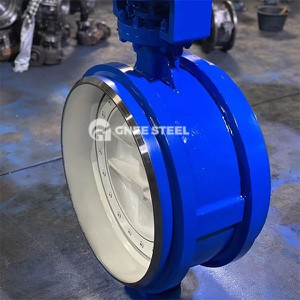
The electric butterfly valve consists of two parts: the electric actuator and the butterfly valve body. The butterfly valve body includes the valve body, butterfly plate (circular valve disc), valve stem and sealing assembly. The valve stem drives the butterfly plate to rotate in the range of 0-90° to control the on-off and flow regulation of the pipeline medium. The electric actuator transmits the motor torque to the valve stem through the reduction device to achieve automatic control.
2. Working principle
Opening and closing control
The electric actuator drives the valve stem to rotate after receiving the electrical signal. When the butterfly plate rotates to 0°, the pipeline is completely closed, and when it rotates to 90°, it is fully open, and the flow is adjusted by the intermediate angle.
Automated adjustment
The integrated controller can adjust the butterfly plate opening in real time according to the preset parameters. For example, by detecting the pressure change, the valve angle is adjusted linearly (such as detecting and adjusting the opening and closing amplitude every 10 seconds), avoiding the impact action of the traditional valve.

3. Core advantages
Efficient fluid control
The butterfly plate has a compact structure, and the fluid resistance is only 1/3 of the gate valve, which is suitable for large flow scenarios.
Fast response and precise operation
The electric drive can achieve opening and closing in seconds, and supports 4-20mA signal input, meeting the real-time control needs of industrial automation systems.
Multi-function adaptability
It has both cutoff, adjustment and non-return functions, and is suitable for water, steam, oil, gas and particle-containing media.
Emergency manual switching
Equipped with a manual operating device, temporary manual control can be performed in case of power failure to ensure system continuity.
4. Typical application scenarios
Industrial field: high-temperature steam control of petrochemical pipelines, cooling water flow regulation of power systems;
Municipal engineering: water supply network pressure balance, sewage treatment plant medium cutoff;
Special working conditions: powder transportation, corrosive liquid management and other scenes that require explosion-proof or anti-corrosion design.
5. Key points for design and selection
Sealing form: Soft seals such as nitrile rubber and polytetrafluoroethylene are used for conventional media, and carbide seals are suitable for high temperature and high pressure conditions;
Connection method: The clamp type is suitable for compact space, and the flange type is suitable for high pressure and large diameter pipelines;
Pressure rating: Covering 1.0MPa to 4.0MPa (PN10~PN40), high temperature models can withstand 450℃ media.
Summary
The electric butterfly valve achieves precise fluid control by rotating the butterfly plate electrically, and has the characteristics of high efficiency, durability, and automation. It is the core equipment for cutting off, throttling, and flow regulation in industrial pipeline systems. Its design needs to be selected and adapted based on the medium characteristics, pressure temperature, and control accuracy requirements.