

Manual valves are entirely driven by human power. Operators open or close the valve by rotating a handwheel, pulling a handle, or operating a worm gear reducer, thus requiring on-site personnel to perform the actions. Automatic valves, on the other hand, are driven by external energy sources, commonly including compressed air (pneumatic), electricity (electric), or hydraulic oil (hydraulic), and are opened and closed by an actuator mounted on the valve.
Whether you need an economical manual ball valve or a high-performance automatic control valve, submit your specifications and get a quote within 1 hour!
Attributes & Operation Comparison
| Comparison Item | Manual Valve | Automatic (Actuated) Valve |
| Power Source | Human Power (Handwheel, Lever, Gearbox) | Pneumatic, Electric, or Hydraulic (with Actuator) |
| Control Mode | Local Operation: Personnel must be on-site | Remote Control: Managed via PLC/DCS signals |
| Response Speed | Slow: Dependent on human strength and distance | Very Fast: Seconds or Milliseconds; consistent and adjustable |
| Precision | Based on visual or manual feel (cannot precisely control opening) | High: Capable of 0.1% precise modulation via a positioner |
| Repeatability | Poor: Highly influenced by human factors | Excellent: Programmed operation ensures process consistency |
| Frequency | Low: Only for maintenance, inspection, or start-up/shut-down | High: Supports 24/7 high-frequency switching or modulation |
Safety & Performance Comparison
| Parameter Category | Manual Valve | Automatic (Actuated) Valve |
| Fail-Safe Mode | None: Stays in position after power/air loss; requires manual intervention | Built-in Fail-Safe: Automatically opens, closes, or stays in position upon failure |
| Emergency Shut-Down (ESD) | Not Capable: Human response is too slow; environment may be hazardous | Core Function: Can rapidly isolate hazards within 1–2 seconds |
| Torque/Thrust Output | Limited: Manually opening large-bore valves is extremely difficult | High Thrust/Torque: Easily drives ultra-large-bore valves |
| Feedback Signals | None: Unless mechanical limit switches are externally installed | Real-time Monitoring: Built-in position, pressure, and status feedback |
| Hazardous Environment | High Risk: Personnel must enter the hazardous area | Safe: No personnel entry required; suitable for toxic, high-pressure, or radiation zones |
| Protection (Ex/Leak) | Naturally Explosion-proof: But packing wears from frequent manual operation | Ex-proof Accessories Required: Can be fitted with bellows for zero-leakage |
Economic & Maintenance Comparison
| Item | Manual Valve | Automatic (Actuated) Valve |
| Initial CAPEX | Very Low: Only the cost of the valve body | High: Includes actuator, solenoid, controller, etc. |
| Installation Difficulty | Simple: Only requires flange or thread connection | Complex: Requires cabling, air lines, and signal commissioning |
| Long-term OPEX | High Labor Costs: Low production efficiency | Energy & Maint. Costs: High output efficiency justifies costs |
| Maintenance Workload | Small: Routine lubrication only | Larger: Requires regular checks on air lines, circuits, and actuator seals |
| Failure Rate | Extremely Low: Simple mechanical structure | Medium: Numerous accessories prone to signal or air supply interference |
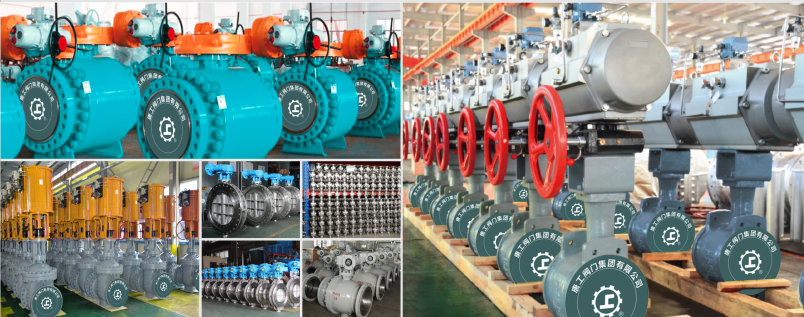
GNEE Valve factory
FAQ
What is a manual ball valve used for?
Manual ball valves are used in a wide range of industrial, commercial, and residential systems where straightforward on/off control is needed. Common applications include water distribution, HVAC systems, compressed air lines, and general-purpose industrial piping.
What is an automatic valve?
Automated valves do not require manual efforts for their operation. Rather, they possess an actuator and control system that automatically performs the opening, closing, and regulation of the valve. Benefits of this system include increase in efficiency and operator safety.
How does a manual valve work?
Manual valves are mechanical devices designed to start, stop, or regulate the flow of fluids or gases by manual means. They are operated using a handle or lever, allowing operators to control the flow rate and pressure within a pipeline or system.