

The core difference between A105 and A105N valves lies in their heat treatment process, while their chemical composition is identical: A105 is a carbon steel forging without a specified heat treatment state, while A105N must undergo normalizing treatment to improve microstructure uniformity and mechanical property stability.
A105 is the basic condition, and can be delivered in annealed, normalized, or non-heat-treated condition according to order requirements. The specific process is determined by the manufacturer based on the application conditions. The "N" in A105N clearly stands for "Normalized", which means that the material must be heated to about 900°C and then uniformly cooled in air to refine the grains, eliminate internal stress, and improve the uniformity of the microstructure, thereby obtaining more stable mechanical properties and better weldability.
Because of its normalizing treatment, A105N is more suitable for applications requiring high material toughness, impact resistance, and weldability, such as high-pressure steam systems, low-temperature environments, or conditions involving thermal cycling. Ordinary A105 is mostly used in normal temperature and pressure, non-critical piping systems, offering advantages in cost-sensitive projects.
It is worth noting that in valve standards such as ASME B16.34, many design requirements explicitly specify the use of A105N instead of A105, precisely for considerations of material consistency and safety margin.
Whether you need A105 cost-efficiency or A105N performance-Click here for the optimal forged steel valve solution.
A105 Valve and A105N Valve Comparison
| Comparison Item | ASTM A105 | ASTM A105N |
| Material Category | Carbon Steel Forging | Carbon Steel Forging (Normalized) |
| Heat Treatment | Not mandatory (depends on size/class) | Mandatory Normalizing (N) |
| Marking / Suffix | A105 | A105N |
| Grain Structure | Potentially coarse and uneven | Refined, uniform, and stable |
| Internal Stress | Higher (Residual forging stress) | Very Low (Eliminated via Normalizing) |
| Cost | Lower | Slightly higher (Due to heat treatment process) |
A105 Valve vS A105N Valve Mechanical Properties
| Parameter | ASTM A105 | ASTM A105N |
| Tensile Strength | ≥ 485 MPa (70 ksi) | ≥ 485 MPa (70 ksi) |
| Yield Strength | ≥ 250 MPa (36 ksi) | ≥ 250 MPa (36 ksi) |
| Elongation | ≥ 22% | ≥ 22% (Usually higher in practice) |
| Reduction of Area | ≥ 30% | ≥ 30% |
| Hardness (HB) | ≤ 187 | ≤ 187 |
| Low-Temp Impact Toughness | Moderate (Not guaranteed) | Excellent (Less prone to brittle fracture) |
A105 Valve and A105N Valve Application and Service Comparison
| Scenario / Service | ASTM A105 (As-Forged) | ASTM A105N (Normalized) |
| Operating Temp | Ambient; Max 425°C | -29°C to 425°C (Better low-temp performance) |
| Pressure Class | Limited to small sizes below Class 300 | Suitable for all classes (Class 300 & above) |
| Environmental Stability | Prone to fatigue cracks from temp changes | Strong resistance to fatigue & crack propagation |
| Industry Usage | Auxiliary systems, water treatment, non-critical | Oil, Gas, Refining, Power core pipelines |
| Code Recommendation | Simple, non-critical applications | Critical applications, pressure vessel accessories |
GNEE A105 and A105N Valve factory
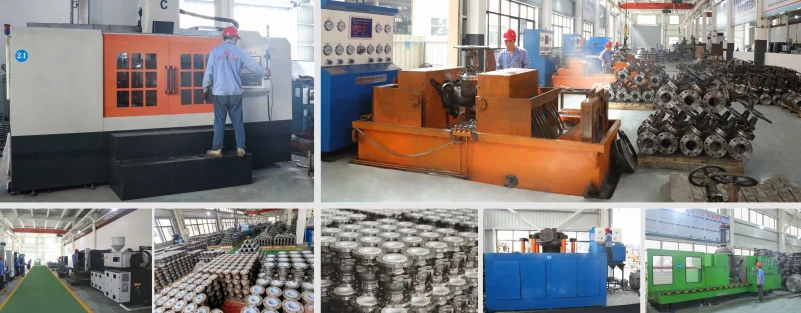
Looking for High-Quality A105N Forged Valves? Submit your specs for a factory-direct quote and stock list in 15 minutes.
FAQ
What does ASTM A105 mean?
ASTM A105 is one of the most commonly used carbon steel specifications for forged piping components such as flanges, fittings, valves, and similar parts. Known for its versatility, strength, and cost-effectiveness, A105 carbon steel is widely used in pressure systems with ambient- and high-temperature service.
Is ASTM A105 casting or forging?
A 105 is an ASTM steel forging specification mainly used for carbon steel forged piping components. This type of carbon steel forging alloy involved is a low carbon, manganese and silicon containing steel similar to AISI 1330, but with lower manganese content.
What is material grade A105N?
A105N is a carbon steel forging material that is widely used in manufacturing industrial valves and piping components. It has excellent mechanical properties and durability, making it suitable for high-temperature and high-pressure environments.