


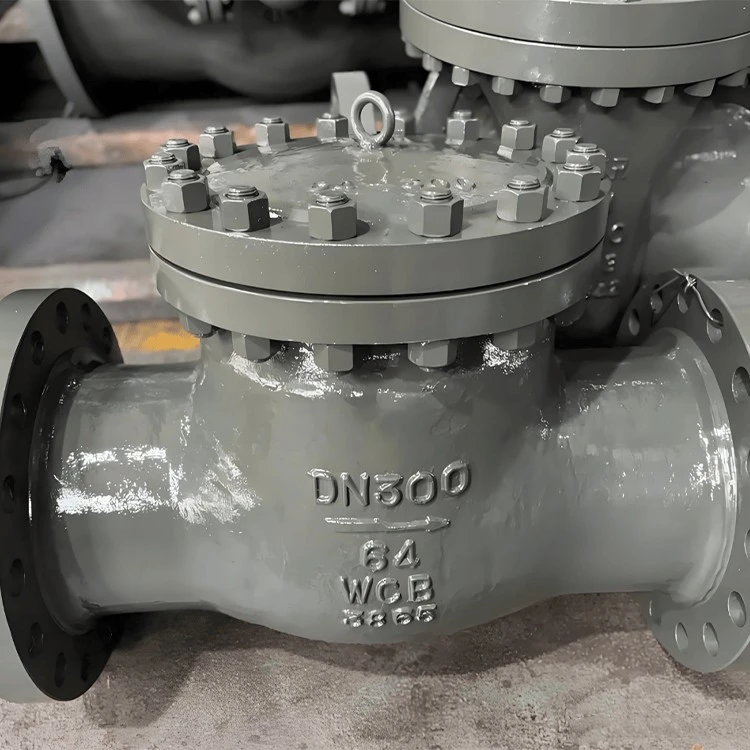
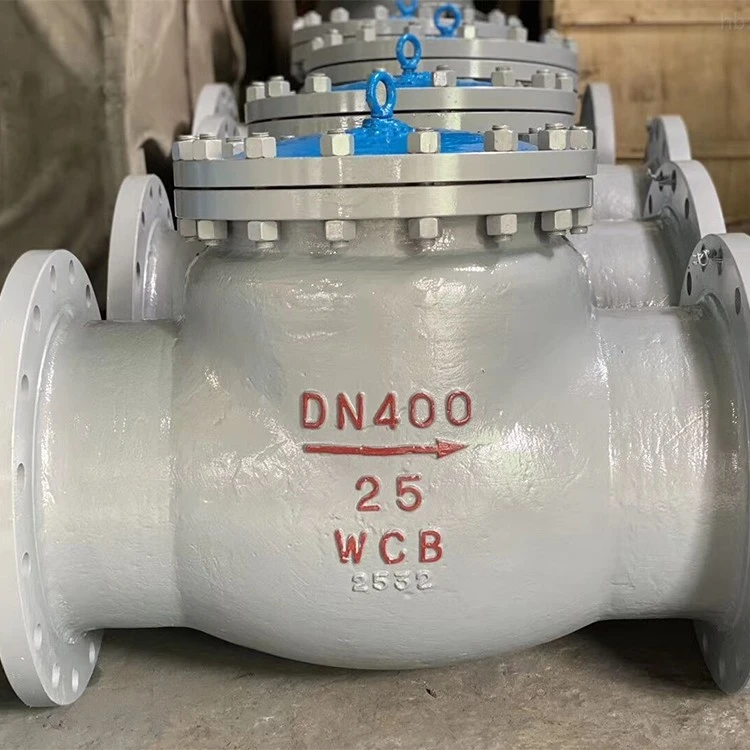
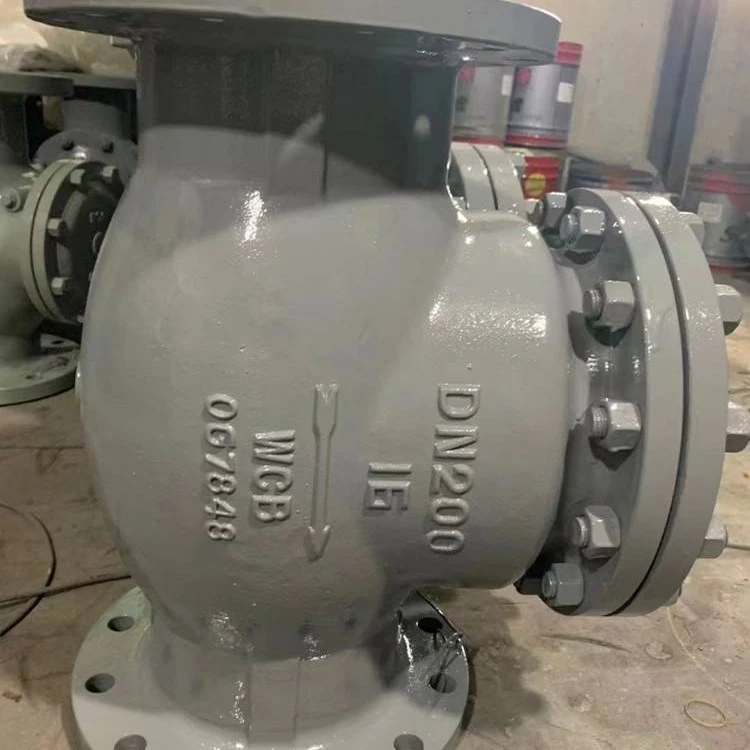
WCB swing check valve is an industrial-grade unidirectional flow control device manufactured from ASTM A216 WCB cast carbon steel in accordance with BS 1868 or API 6D standards; it operates by utilizing fluid pressure to push open a disc that swings in an arc around a hinge pin, closing automatically via gravity and backpressure when flow ceases or reverses.
Typically featuring API Trim 8 (13Cr stainless steel with Stellite hardfacing) for durability in environments ranging from -29°C to 425°C, this valve is characterized by its full-bore design-providing a high flow coefficient (Cv of approximately 2000 for DN200) and a low cracking pressure (0.03–0.05 MPa)-making it an essential component in oil, gas, and saturated steam pipelines for preventing backflow and mitigating water hammer damage.
Fully compliant with BS 1868 & API 598 testing. Click here to request our quality certifications and test reports.
Swing Check Valves DN200 PN40-WCB drawning

Construction
The typical internal structure of a swing check valve consists of the following components:
Valve Body: A WCB cast steel component featuring a streamlined flow path to minimize pressure drop.
Bonnet: Connected to the body via bolts, allowing for easy maintenance and replacement of internal parts.
Disc: The primary moving component that rotates. It is usually equipped with a sealing surface (e.g., 13Cr or Stellite hardfacing).
Hinge Arm: The component that connects the disc to the hinge pin.
Hinge Pin: Fixed within the valve body, providing the axis around which the disc rotates.
Seat Ring: The valve seat sealing surface, typically made with stainless steel hardfacing.
Gasket: Ensures the seal between the body and the bonnet (usually a spiral wound gasket).
Specification Table
| Item | Technical Requirements / Parameters |
| Design Standard | BS EN 16767 / DIN 3356 / API 594 (Ref.) |
| Pressure Rating | PN10, PN16, PN25, PN40 |
| Nominal Diameter | DN50 - DN600 (Current: DN200) |
| Body Material | ASTM A216 WCB (Carbon Steel) |
| Sealing / Trim Material | 13Cr Stainless Steel or Stellite (Hard Alloy) |
| Applicable Medium | Water, Steam, Oil, Non-corrosive liquids |
| Operating Temperature | -29℃ to 425℃ |
| Connection Type | Flanged (RF / RTJ) |
| Flange Standard | EN 1092-1 / DIN 2501 |
| Shell Test Pressure | 6.0 MPa (1.5x Nominal Pressure) |
| Seal Test Pressure | 4.4 MPa (1.1x Nominal Pressure) |
| Painting Color | Industrial Grey / Blue / Silver (Customizable) |
Features
Low Flow Resistance: In the fully open position, the flow path is nearly unobstructed, resulting in lower pressure loss compared to lift check valves.
Reliable Sealing: The disc is pressed tightly against the seat by the backpressure of the medium; higher pressure results in a tighter seal.
Flexible Installation: Can be installed horizontally or on vertical pipelines where the medium flows from bottom to top.
Durability: The WCB material withstands significant temperature fluctuations. Combined with hardfaced sealing surfaces, it is highly resistant to erosion and offers a long service life.
Internal Hinge Pin Design: Modern designs often utilize an internal pin, which reduces external leakage points (no external pin plugs).
GNEE Valve workshop

FAQ
What is the problem with swing check valves?
Swing check valves have four primary practical flaws:
Water Hammer (Slamming): The disc slams shut violently when flow reverses, causing massive pressure surges that can rupture pipes or supports.
Disc Chattering: In low-velocity flows, the disc "hovers" and vibrates, which rapidly wears out the hinge pin and can cause the disc to detach.
Hinge Misalignment: Constant friction wears down the pin over time, causing the disc to sag and fail to seal properly against the seat.
Debris Trapping: The bottom of the valve body acts as a "pocket" where sediment or scale collects, often preventing the disc from closing fully.
What does WCB mean on valves?
WCB is cast carbon steel, whereas its forged counterpart is A105. When marked on a valve, it indicates the material of the valve body. WCB is an American grade, equivalent to the domestic Chinese grade ZG280-520.
Can you manually open a swing check valve?
The operation of swing check valves primarily falls into two categories: manual and automatic. The specific method employed depends on the requirements of the application scenario.
For manually operated swing check valves, opening and closing are actuated via a hand crank, handwheel, or other manual mechanisms. This mode of operation is suitable for situations where precise timing of the valve action is not critical, fluid flow rates are relatively low, and the operational environment is relatively simple.
Hot Tags: wcb swing check valves, China wcb swing check valves manufacturers, suppliers, factory, check valve backflow prevention, check valve for refineries, nozzle type check valve, Tilting Disc Check Valve, silent type check valve, check valve upgrade