

Supply at a Glance
The valves have been supplied to offshore oil and gas developments on the Chinese continental shelf continuously from 2019 to the present, covering multiple basins including the Bohai Sea and the Pearl River Mouth, and facility types from wellhead platforms to FPSO topsides.
| Scope | Coverage |
|---|---|
| Service period | Since 2019, continuous supply to offshore developments in China |
| Regions | Multiple offshore basins, including the Bohai Sea and Pearl River Mouth |
| Facility types | Wellhead platforms, processing fields, FPSO topsides, modular drilling rigs |
| Valve family | Gate, globe, check, ball and butterfly valves |
| Service condition | Sour service, low temperature, fire-safe, marine (C5-M) |
Valve Types and Engineering Scope
Offshore installations draw on the complete valve family rather than a single type. The package supplied for these developments covered the isolation and flow-control functions across process, utility and seawater systems.
Gate valves - API 600 / API 602, OS&Y, for main line isolation on process and utility headers.
Globe valves - API 600 / BS 1873, for throttling and regulation on injection and chemical lines.
Check valves - API 594 / API 6D, swing and dual-plate, for backflow prevention on pump and compressor discharges.
Ball valves - API 6D / API 608, trunnion and floating, full bore with double block and bleed for manifold isolation.
Butterfly valves - API 609 / BS 5155, large-bore, for cooling-water, deluge and fire-water duties.
Engineering Requirements
Offshore China service sets a consistent engineering baseline that the supplied valves were qualified against.
Sour service. Reservoir fluids carry H₂S and CO₂, so materials follow NACE MR0175 / ISO 15156 with hardness on load-bearing parts held at or below 22 HRC.
Low temperature. Bohai Sea fields operate through cold winters; exposed and shutdown lines were specified in low-temperature carbon steel (A352 LCC, qualified to −46 °C).
Fire safety. Hydrocarbon-service valves were fire-safe to API 607 with a graphite secondary seal and antistatic ball-to-stem bonding per API 6D.
Marine environment. External surfaces carried an ISO 12944 C5-M coating for continuous salt-fog exposure on open decks and topsides.
Standards and Certification
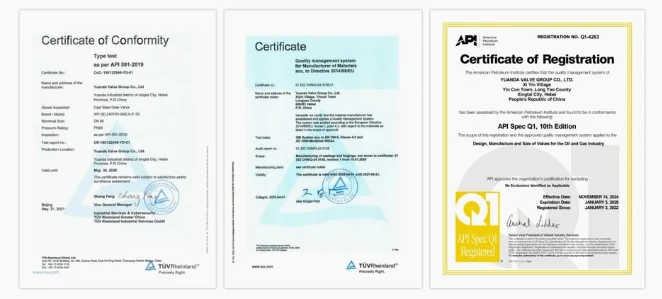
Design and testing followed the relevant API and BS standards, with GB/T standards applied where the Chinese special-equipment framework requires. Pressure-equipment compliance was handled under PED 2014/68/EU for export and the Chinese TS special-equipment licence for domestic supply. Quality management runs to ISO 9001, and API monogramming was applied where the purchase order specified it.
Inspection and Acceptance
A third-party inspector witnessed the pressure tests so the record belonged to the shipment rather than a sample. Shell test ran at 1.5× design pressure and seat test at 1.1× design pressure, both to zero leakage. Each valve shipped with an EN 10204 3.1 material certificate, upgraded to 3.2 where TPI endorsement was required, backed by positive material identification, a hardness survey on sour-service parts, and magnetic-particle testing on welded bodies.
FAQ
Which valve types are supplied for offshore oilfield projects in China?
The supply covers the full isolation and flow-control set used on offshore installations: gate valves for line isolation, globe valves for throttling, check valves for backflow prevention, ball valves for manifold and DBB service, and butterfly valves for large-bore utility and seawater duties. Together they cover wellhead platforms, processing topsides and FPSO systems.
What standards apply to these offshore valves?
Valves are built to API 600 / 602 (gate), API 594 and API 6D (check and ball), API 608 / 609 and BS 5155 (ball and butterfly), with GB/T standards applied where the Chinese special-equipment framework requires. Pressure-equipment compliance follows PED 2014/68/EU for export and the Chinese TS special-equipment licence domestically.
How are sour-service and low-temperature requirements met?
Offshore China reservoirs carry H2S and CO2, so sour-service materials follow NACE MR0175 / ISO 15156 with hardness control on load-bearing parts. Bohai Sea fields operate through cold winters, so low-temperature carbon steel (A352 LCC, qualified to -46 C) is specified for exposed and shutdown lines. Both requirements are verified on the material certificates.
What inspection and certification accompany the valves?
Each valve ships with an EN 10204 3.1 material certificate, upgraded to 3.2 where third-party inspection is specified. A TPI witness attends hydrostatic and seat tests; shell test runs at 1.5x design pressure and seat test at 1.1x with zero leakage. Positive material identification, hardness survey and magnetic-particle testing on welds are recorded against the purchase order.
Can valves be supplied for FPSO topsides and drilling rigs?
Yes. FPSO and drilling-rig service demands fire-safe certification to API 607, an ISO 12944 C5-M marine coating for continuous salt-fog exposure, and anti-vibration mounting for topside skids. The FPSO and modular drilling-rig valves are supplied to that specification, with actuators tested as a complete assembly before shipment.
What is the supply track record and how is scheduling handled?
Valves have been supplied to offshore developments in China continuously from 2019 to the present, spanning multiple basins including the Bohai Sea and Pearl River Mouth. Deliveries are scheduled to each project's milestone plan rather than to a fixed catalogue lead time, with priority on weld-end and package-kitting readiness for platform integration.