

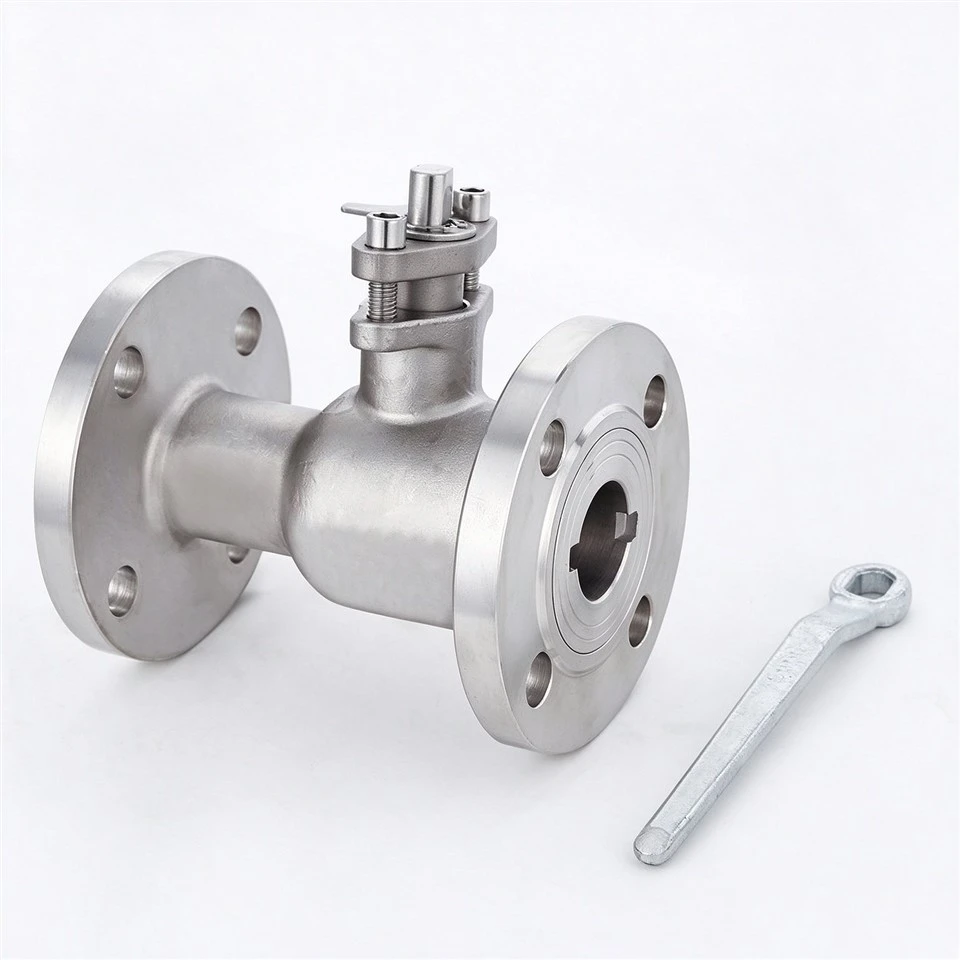


1 PC cast steel floating ball valve is a quarter-turn isolation valve with an integral ASTM A216 WCB cast body and a floating ball that seals against the downstream seat under line pressure. It suits low- to medium-pressure utility and process lines where a compact, economical shutoff is required. Submit your specification to confirm size, pressure class, seat material and inspection requirements.
Floating Ball Sealing Principle
In a floating ball valve the ball is not anchored by a trunnion. Under line pressure the ball moves slightly and loads the downstream seat, so the upstream seat is spring- or pre-loaded and the downstream seat is energized by the medium - a single-direction, self-energizing seal. With soft seats (PTFE / RPTFE) this gives bubble-tight shutoff at low operating torque.
For soft-seated versions, seat leakage is verified to ISO 5208 Rate A (bubble-tight, zero visible leakage) at the specified test pressure. Seat leakage for metal-seated versions is verified to ISO 5208 Rate D. Testing is carried out per API 598, ISO 5208 or EN 12266-1 as applicable.
Design Standards
| Basic Design | API 608/ASME B16.34/ISO 17292/API 6D |
| Face to Face/ End to End | ASME B16.10 |
| Flange End | ASME B16.5 |
| Buttwelding End | ASME B16.25 |
| Pressure-temperature Rating | ASME B16.34 |
| Inspection and Test | API 598 |
| Firesafe Design | API 607/API 6FA |
Design Feature
1. Double sealing system of packing, and firesafe design
2. Stem with emergency grease injection
3. Integral anti-blowout design structure of the stem
4. Optional locking device
5. Independent limit structure design
6. Anti-static function
7. Low torque design
8. Solid ball design
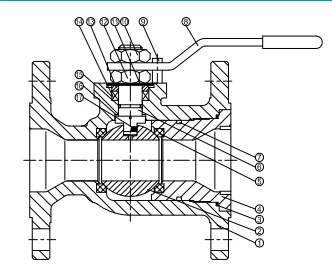
General Assembly Drawing
Material of Construction
| Part No. | Part Name | Carbon Steel | Stainless Steel | Low Temperature |
|---|---|---|---|---|
| 1 | Body | ASTM A216 WCB | ASTM A351 CF8M | ASTM A352 LCB/LCC |
| 2 | Ball | ASTM A105N+ENP | ASTM A182 F316 | ASTM A350 LF2+ENP |
| 3 | Gasket | Graphite | Graphite | Graphite |
| 4 | Body Insert | ASTM A105N | ASTM A182 F316 | ASTM A350 LF2 |
| 5 | Seat | PTFE | PTFE | PTFE |
| 6 | Stem | ASTM A182 F6a | ASTM A182 F316 | ASTM A182 F316 |
| 7 | O-Ring | FKM | FKM | FKM |
| 8 | Handle | Carbon Steel | ASTM A240 304 | ASTM A240 304 |
| 9 | Stop Pin | Carbon Steel | ASTM A193 B8M | ASTM A320 L7 |
| 10 | Nut | Carbon Steel | ASTM A194 8M | ASTM A194 4 |
| 11 | Belleville Spring | Alloy Steel | Alloy Steel | Alloy Steel |
| 12 | Nut | Carbon Steel | ASTM A194 8 | ASTM A194 7 |
| 13 | Gland | ASTM A276 410 | ASTM A276 316 | ASTM A276 304 |
| 14 | Packing | Graphite | Graphite | Graphite |
| 15 | O-Ring | FKM | FKM | FKM |
| 16 | Thrust Washer | PTFE | PTFE | PTFE |
| 17 | Anti-static Device | Stainless Steel | Stainless Steel | Stainless Steel |
Dimension & Weight
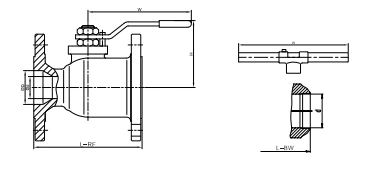
CLASS150 Reduced Port
| Size | d | D | L-RF | L-BW | H | W | Approx Weight | ||||||||
|---|---|---|---|---|---|---|---|---|---|---|---|---|---|---|---|
| NPS | DN | in | mm | in | mm | in | mm | in | mm | in | mm | in | mm | lb | kg |
| 3/4×1/2 | 20 | 0.51 | 13 | 0.75 | 19 | 4.61 | 117 | 5.98 | 152 | 3.50 | 89 | 5.08 | 129 | 13 | 6 |
| 1×3/4 | 25 | 0.75 | 19 | 0.98 | 25 | 5.00 | 127 | 6.50 | 165 | 3.54 | 90 | 6.69 | 170 | 15 | 7 |
| 1½×1 | 40 | 1.26 | 32 | 1.50 | 38 | 6.50 | 165 | 7.48 | 190 | 4.17 | 106 | 8.82 | 224 | 17 | 8 |
| 2×1½ | 50 | 1.50 | 38 | 1.93 | 49 | 7.01 | 178 | 8.50 | 216 | 4.37 | 111 | 8.82 | 224 | 26 | 12 |
| 3×2 | 80 | 1.93 | 49 | 2.91 | 74 | 7.99 | 203 | 11.14 | 283 | 5.75 | 146 | 14.02 | 356 | 51 | 23 |
| 4×3 | 100 | 2.91 | 74 | 3.94 | 100 | 9.02 | 229 | 12.01 | 305 | 6.73 | 171 | 14.02 | 356 | 84 | 38 |
| 6×4 | 150 | 3.94 | 100 | 5.91 | 150 | 10.51 | 267 | 17.99 | 457 | 9.69 | 246 | 21.50 | 546 | 176 | 80 |
Seat Materials and Temperature Range
| Seat material | Typical service temperature | Note |
|---|---|---|
| PTFE | −29 °C to +180 °C | Soft, bubble-tight (ISO 5208 Rate A) |
| RPTFE (glass-filled) | −29 °C to +200 °C | Higher temperature than PTFE |
| PPL / PEEK | Higher, per grade | Confirm with medium and pressure |
| Metal seat | Higher than soft seat | ISO 5208 Rate D leakage |
Safety Features
Fire-safe design per API 607 (optional), with a graphite secondary seal that maintains shutoff after the soft seat is destroyed by fire.
Anti-static construction per API 608: electrical continuity between ball, stem and body (typically < 10 Ω) to prevent static discharge.
Blow-out proof stem per API 608: the stem is retained by a shoulder below the bonnet, so it cannot be ejected under pressure if the packing is removed.
ISO 5211 actuator mounting flange for lever, gear, pneumatic or electric operation.
Optional locking device to secure the open/closed position.
Manufacturing, Testing and Inspection
| Test / check | Requirement | Reference |
|---|---|---|
| Shell (body) hydrostatic | 1.5 × rated pressure, no visible leakage | API 598 / ISO 5208 / EN 12266-1 |
| Seat test (water) | 1.1 × rated pressure, ISO 5208 Rate A (soft seat) | API 598 / ISO 5208 / EN 12266-1 |
| Low-pressure air seat test | Optional, per project specification | API 598 / EN 12266-1 |
| Anti-static | Continuity ball–stem–body < 10 Ω | API 608 |
| Stem | Blow-out proof | API 608 |
| Traceability | Heat number on body and MTC | Works practice |
Specific test pressures, acceptance criteria and exceptions are defined by the applicable standard edition, valve class, seat material and purchase order.
Applications
Utility and auxiliary piping where a compact, low-cost shutoff is sufficient.
Water supply, HVAC chilled-water and building services circuits.
Oil and gas gathering and low-pressure process lines.
Steam and mildly corrosive media within the seat temperature limit.
Services where a reduced bore and non-field-repairable design are acceptable.
Suitability depends on design pressure, service temperature, medium and maintenance strategy. A 1-piece valve is not selected for services that require in-line seat replacement or full-bore pigging.
Material Certificates and Documentation
Standard documentation includes a Material Test Certificate to EN 10204 3.1 covering body and trim chemistry and mechanical results, the pressure-test record, and a declaration of anti-static and blow-out-proof construction where applicable. Positive Material Identification (PMI) and third-party inspection (e.g., SGS / TÜV / BV) are available on request. Each valve carries a heat number for traceability against the MTC.
Coating, Packing and Delivery
External surfaces are supplied with anti-corrosion primer or paint, or as otherwise specified. Ends are protected with plastic caps or plugs. Valves are packed in cartons or plywood cases with identification tags, and shipped with commercial invoice, packing list, bill of lading and the relevant certificates. Destination, Incoterms and schedule are confirmed per order.
Provide the following to receive a quotation: nominal size (NPS/DN) and pressure class, end connection (NPT/BSPT/SW), body material (WCB/LCB/WC6), seat material, fire-safe / anti-static / actuation requirements, inspection and documentation needs, quantity, destination and requested schedule, and drawing or technical specification.
FAQ
What is a 1 PC cast steel floating ball valve?
A 1 PC cast steel floating ball valve is a quarter-turn isolation valve with an integral ASTM A216 WCB cast body and a floating ball that moves slightly under line pressure to load the downstream seat. It provides bubble-tight shutoff for low- to medium-pressure utility and process lines.
What does "1-piece" (1 PC) body construction mean?
"1-piece" means the valve body is a single cast component (unibody) with no bolted body joint. Internal parts are inserted through the end port, so the body has the fewest potential leak paths but cannot be disassembled for in-line service.
What is the difference between a 1-piece, 2-piece and 3-piece ball valve?
A 1-piece valve is a solid cast body with a reduced bore and no in-line repairability; a 2-piece valve splits into two bolted halves, usually full bore, repairable off-line; a 3-piece valve has a removable center body that swings out for in-line seat and seal replacement.
Is a 1-piece ball valve repairable in the field?
Generally no. Because the body is a sealed unibody, the seats and seals cannot be replaced in the line. When the soft seat wears out, the whole valve is replaced. Evaluate this against your maintenance plan before specifying.
What material is used for the cast steel body?
The standard body material is ASTM A216 WCB carbon steel casting. Low-temperature service uses A352 LCB or LCC, and high-temperature service uses A217 WC6 or WC9, selected by the media temperature and project specification.
What standards apply to a 1-piece cast steel floating ball valve?
Design is typically to API 608, with pressure-temperature limits per ASME B16.34 and general-purpose references to ISO 17292 and BS 5351. Ends follow ASME B16.5 or B16.11, and testing follows API 598, ISO 5208 or EN 12266-1. The applicable edition is defined by the purchase order.
What is the seat leakage class of a soft-seated floating ball valve?
For soft-seated versions, seat leakage is verified to ISO 5208 Rate A - bubble-tight, zero visible leakage - at the specified test pressure. Testing is carried out per API 598, ISO 5208 or EN 12266-1 as applicable.
What information is needed to request a quotation?
Provide the nominal size and pressure class, end connection, body material, seat material, fire-safe/anti-static/actuation requirements, inspection and documentation needs, quantity, destination and schedule, and any drawing or datasheet.
Hot Tags: 1 pc cast steel floating ball valve, China 1 pc cast steel floating ball valve manufacturers, suppliers, factory, ball valve drain valves, ball valve fill valves, ball valve installation, ball valve marking, ball valve pneumatic couplings, ball valve suppliers