


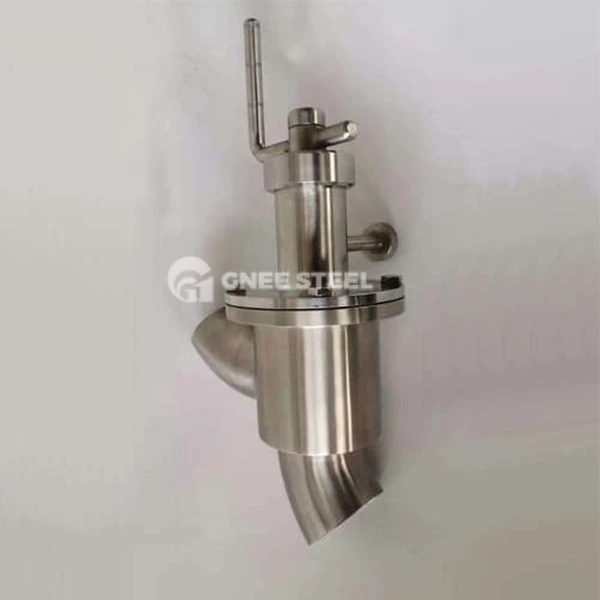
Sanitary globe valve Description
Sanitary globe valve is a valve designed for high-sanitary standard industries such as food, pharmaceuticals, and bioengineering. It can accurately cut off the medium and adjust the flow rate by lifting the valve disc. Its core features include:
Non-toxic materials: the valve body is made of 316L stainless steel or titanium alloy, and the seals are made of corrosion-resistant and pollution-free materials such as silicone rubber and PTFE;
Surface treatment: mirror polishing of the inner and outer surfaces (roughness Ra≤0.8μm) to avoid medium residue and microbial growth;
Structural optimization: the flow channel has no dead angle, supports online cleaning (CIP) and online sterilization (SIP), and is suitable for sterile environments.
Sanitary globe valve Specification
Diameter range:
Conventional models: DN15~DN100 (suitable for small flow precision control scenarios);
Special needs: can be expanded to DN150 (such as large dairy production lines).
Pressure and temperature:
Pressure level: PN10~PN16 (mainly Class 150), some high-temperature models support PN40;
Temperature range: -20℃~+180℃ (standard material), high-temperature sterilization scenarios can reach +250℃ (special sealing materials).
Production standards:
3A sanitary standards: American Dairy Association specifications, mandatory requirements for non-toxic materials and easy-to-clean structures;
DIN 11851: German sanitary connection standard, which specifies valve interface size and surface finish;
FDA certification: Materials must comply with FDA 21 CFR 177.2600 food contact standards.
Testing items:
Surface roughness test: Laser interferometer verification Ra value ≤ 0.8μm;
Sealing verification: ISO 5208 A-level airtightness test, leakage rate ≤ 10⁻⁶ mbar·L/s;
Corrosion resistance test: ASTM G48 salt spray test ≥ 96 hours without rust.
Sanitary globe valve


Application and core role
Food and beverage industry:
Function: Control the aseptic delivery of fluids such as milk and juice to prevent cross contamination;
Typical scenarios: Filling line valves, fermentation tank import and export control.
Pharmaceutical and bioengineering:
Function: Accurately adjust the flow of active ingredients such as vaccines and antibiotics to meet GMP clean requirements;
Typical scenarios: Bioreactor pipelines, aseptic filling systems.
Cosmetics industry:
Function: Ensure the non-residue delivery of media such as spices and lotions to prevent batch contamination.
Differences from other globe valves
Material and surface treatment:
Sanitary valves: 316L stainless steel is mandatory, and ordinary stop valves are allowed to use carbon steel or cast iron;
Polishing requirements: The polishing level of the inner wall of the sanitary valve body (Ra≤0.8μm) is much higher than that of industrial valves (Ra≥1.6μm).
Structural design:
No dead angle flow channel: Sanitary valves adopt straight-through or Y-type design, while ordinary stop valves may have dead angles for residual media;
Quick disassembly: Sanitary valves support clamps or threaded quick-install interfaces, while industrial valves are mostly connected by welding or flanges.
Functional adaptability:
Online cleaning: Sanitary valves have built-in CIP/SIP channels, while ordinary stop valves do not have this function;
Sealing material: Sanitary valve seals must be resistant to high-temperature steam sterilization (≥121℃), while industrial valves mostly rely on ordinary rubber seals.
Hot Tags: sanitary globe valve, China sanitary globe valve manufacturers, suppliers, factory, globe valve for icosahedral materials, globe valve for advanced materials, globe style control valves, globe valve for sodium manufacturing, globe valve for vinyl materials, globe valve for barium oxide manufacturing