

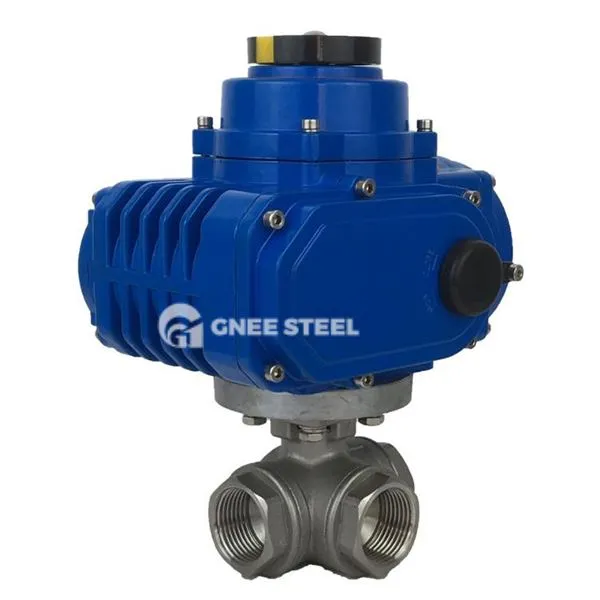


electrically actuated 3 way valve Description
An electrically actuated 3 way ball valve is an integrated flow control assembly combining a three-port ball valve body with an electric actuator for automated flow diversion, media mixing, and pipeline switching.
It is widely used in petrochemical, water treatment, HVAC, marine, and industrial automation systems where remote control and reliable flow switching are required.
This guide explains structure, L-port and T-port differences, working principles, selection criteria, technical limits, and application scenarios in compliance with modern valve engineering standards.
1. Core Composition & Working Mechanism
1.1 Main Structural Components
A typical electrically actuated 3 way ball valve consists of two main parts:
3-way ball valve body
The valve body contains three ports and a rotatable perforated ball. Flow direction is changed by rotating the ball to align internal flow channels.
Electric actuator
The actuator converts electrical signals into rotary motion and drives the valve stem to rotate the ball.
Standard operation: 0–90° quarter-turn rotation
Control input: ON/OFF or modulating signal
Optional: multi-position control (not continuous rotation)
⚠️ Correction: Industrial ball valves do NOT operate in 0–360° continuous rotation mode. They are quarter-turn devices.
1.2 Actuator Control Types
Four common actuator configurations are used:
On/Off type actuator
Provides fully open or fully closed operation for simple flow switching.
Integral type actuator
Compact design with built-in control module for simplified wiring and installation.
Modulating type actuator
Accepts 4–20 mA or 0–10 V signal for proportional positioning control.
Intelligent type actuator
Includes position feedback, diagnostics, and industrial communication protocols (e.g., Modbus, Profibus).
Key Engineering Note
Modulating 3-way ball valves can regulate flow direction and proportion, but they are not suitable for high-precision flow control.
This limitation is due to:
Non-linear flow coefficient (Cv curve)
Interaction between multiple ports
Limited throttling capability of ball geometry
2. L-Port vs T-Port 3 Way Electric Ball Valve
2.1 L-Port Valve (Diverter / Selector Type)
The L-shaped flow channel connects two of the three ports at a time.
Functions:
Flow diversion (one inlet → one of two outlets)
Source selection (two inlets → one outlet)
Typical applications:
HVAC hot/cold water switching
Dual pipeline selection systems
2.2 T-Port Valve (Distribution / Limited Mixing Type)
The T-shaped channel enables more flexible routing.
Functions:
Distribution: one inlet → two outlets
Converging: two inlets → one outlet (conditions dependent)
Limited mixing depending on pressure balance
⚠️ Correction: T-port valves do NOT guarantee equal or proportional mixing. Flow distribution depends on system pressure, resistance, and piping configuration.
Not Sure L-Port or T-Port? Ask Our Engineer
3. Advantages of Electrically Actuated 3 Way Ball Valves
3.1 Automated Remote Operation
Allows centralized control via PLC or DCS systems, eliminating manual intervention.
3.2 Safety in Hazardous Environments
Reduces operator exposure to hazardous media
Enables remote emergency shut-off
Explosion-proof actuator options available (Ex d IIB T4 / T6)
3.3 System Integration Advantages
Electric actuation eliminates the need for compressed air systems required in pneumatic valves, simplifying plant infrastructure.
⚠️ Correction: This improves system simplicity but does not always guarantee lower energy consumption compared to pneumatic systems.
3.4 Compact Mechanical Design
Direct coupling between actuator and valve stem reduces transmission components, improving reliability and reducing maintenance needs.
4. Industrial Applications
4.1 Process Industries
Water treatment: chemical dosing and flow routing
Petrochemical: product transfer switching
Chemical processing: corrosive media distribution
Marine systems: ballast and fuel routing
HVAC systems: hot/cold water regulation
4.2 Building Automation
Used in smart building systems for HVAC optimization and water distribution control.
4.3 Energy Efficiency Systems
Supports automated energy management in thermal fluid and circulation systems.
4.4 Emergency Isolation Systems
Enables rapid remote shut-off of pipelines carrying hazardous media.
5. Technical Specifications & Standards
5.1 Size, Pressure & Temperature Range
Size: DN15 – DN600 (1/2" – 24")
Pressure: PN10 – PN420 / Class 150 – Class 2500
Temperature limits:
PTFE seat: -46°C to 150°C
PPL seat: up to 220°C
Metal seat: -40°C to 450°C
5.2 Materials (Corrected Engineering Version)
Valve body:
ASTM A216 WCB (carbon steel)
ASTM A351 CF8 / CF8M (stainless steel)
Ball:
304 / 316 / 316L stainless steel
Hard chrome plated or tungsten carbide coated (for severe service)
Seat:
PTFE, PPL, metal seat alloys
⚠️ Correction: ASTM A105 is NOT a ball material specification (it is forging material for valve bodies or forged parts).
5.3 Electric Actuator Specifications
Power supply: AC220V / AC380V / DC24V (standard industrial options)
Torque range: 50 N·m – 2000 N·m
Stroke: 0–90° quarter-turn
Operating time: 15–60 seconds
Protection: IP65 / IP67 optional
Optional functions:
Manual override
Position feedback
Limit switches
Explosion-proof housing
5.4 Applicable Standards (Updated)
Design standards:
API 6D (pipeline valve applications)
ISO 17292 (ball valves)
ASME B16.34 (pressure-temperature ratings)
DIN / JIS standards where applicable
Testing standards:
API 598 (pressure testing)
Flange standards:
ASME B16.5 / EN 1092-1
Mounting:
ISO 5211 actuator mounting interface
⚠️ Correction: BS 5351 is obsolete and replaced by ISO 17292.
Send Drawing for OEM / ODM Quotation
electrically actuated 3 way valve


6. Selection Guide
To select a suitable electrically actuated 3 way ball valve:
Step 1: Define operating conditions
Pressure class
Temperature range
Media type
Corrosion requirements
Step 2: Select port type
L-port: switching / diversion
T-port: distribution / limited mixing
Step 3: Choose actuator type
On/off
Modulating (4–20 mA)
Intelligent control system
Step 4: Configure accessories
Explosion-proof rating
Position feedback
Manual override
High/low temperature design
Frequently Asked Questions (FAQ)
Q1: What is the difference between L-port and T-port valves?
L-port valves are used for flow switching and selection.
T-port valves allow distribution or limited mixing depending on system conditions.
Q2: Can a 3 way ball valve provide precise flow control?
No. Three-way ball valves are primarily for flow routing, not precision throttling.
For accurate flow regulation, 2-way control valves are recommended.
Q3: What is the maximum temperature for metal-seated versions?
Metal-seated designs can operate up to approximately 450°C depending on material selection.
Q4: Are explosion-proof actuators available?
Yes. Explosion-proof electric actuators are available for hazardous environments, typically rated Ex d IIB T4/T6.
Q5: What signal types are supported?
Common control signals include:
4–20 mA
0–10 V
Digital communication protocols (Modbus, Profibus)
Q6: What is the protection rating?
Standard actuators are IP65, with IP67 or higher available for outdoor or harsh environments.
Q7: Can 3-way ball valves replace all 2-way valves?
No. They are not suitable for applications requiring stable linear flow regulation or high-precision throttling control.
Hot Tags: Electrically Actuated 3 Way Ball Valves, China Electrically Actuated 3 Way Ball Valves manufacturers, suppliers, factory, Mounted Ball Valve, ball valve labeling, 3 way ball valve with pneumatic actuator, medium pressure ball valve, ball valve gamma ray couplings, ball valve maintenance