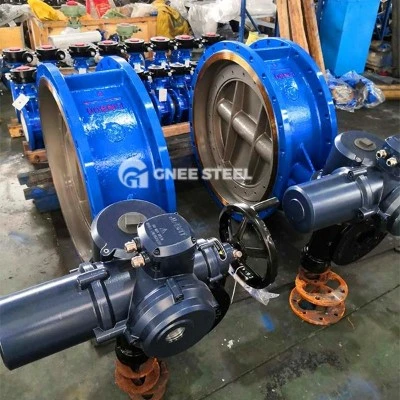
The three-eccentric butterfly valve is a valve that achieves sealing through a three-layer geometric eccentric structure. Its core feature is that the valve stem axis, the center of the butterfly plate and the center of the valve body deviate in sequence and form a specific angle match. This design solves the limitations of the sealing performance and pressure resistance of traditional butterfly valves by changing the sealing contact method.
Specific composition of the three-eccentric valve
First eccentricity (eccentricity between valve stem and butterfly plate)
The rotation axis of the valve stem deviates from the symmetric axis of the butterfly plate, ensuring that the butterfly plate forms a complete contact surface with the valve seat when closed, avoiding friction loss during opening and closing.
Second eccentricity (eccentricity between valve stem and valve body)
The center of the valve stem deviates from the center line of the valve body channel, reducing the friction resistance when the butterfly plate rotates and improving the ease of operation.
Third eccentricity (eccentricity of sealing surface cone angle)
The valve seat sealing surface is in an oblique cone shape, and its axis forms an angle α with the axis of the valve body channel. When closed, the butterfly plate contacts the valve seat in a gradually pressurized manner to achieve zero leakage of the metal sealing surface.

Working principle and performance advantages
Torsion sealing mechanism
Different from traditional elastic deformation seals, the three-eccentric structure directly forms contact surface pressure through the valve stem torque. The sealing strength increases with the increase of medium pressure and can withstand PN10-PN160 pressure levels (up to ANSI CL 900).
High temperature adaptability
The metal hard seal design extends its temperature tolerance range to -196~650℃, which is especially suitable for high-temperature working conditions such as electricity and metallurgy.
Low wear and long life
The butterfly plate quickly disengages/contacts with the valve seat during opening and closing, reducing operating friction, and the life span can reach more than 5 times that of ordinary butterfly valves.
Typical application scenarios
Widely used in high-parameter working conditions of petrochemical and water supply and drainage systems, such as high-temperature steam pipelines, strong corrosive medium interception and precise flow control scenarios. Its bidirectional sealing characteristics give it outstanding advantages in reverse pressure systems.